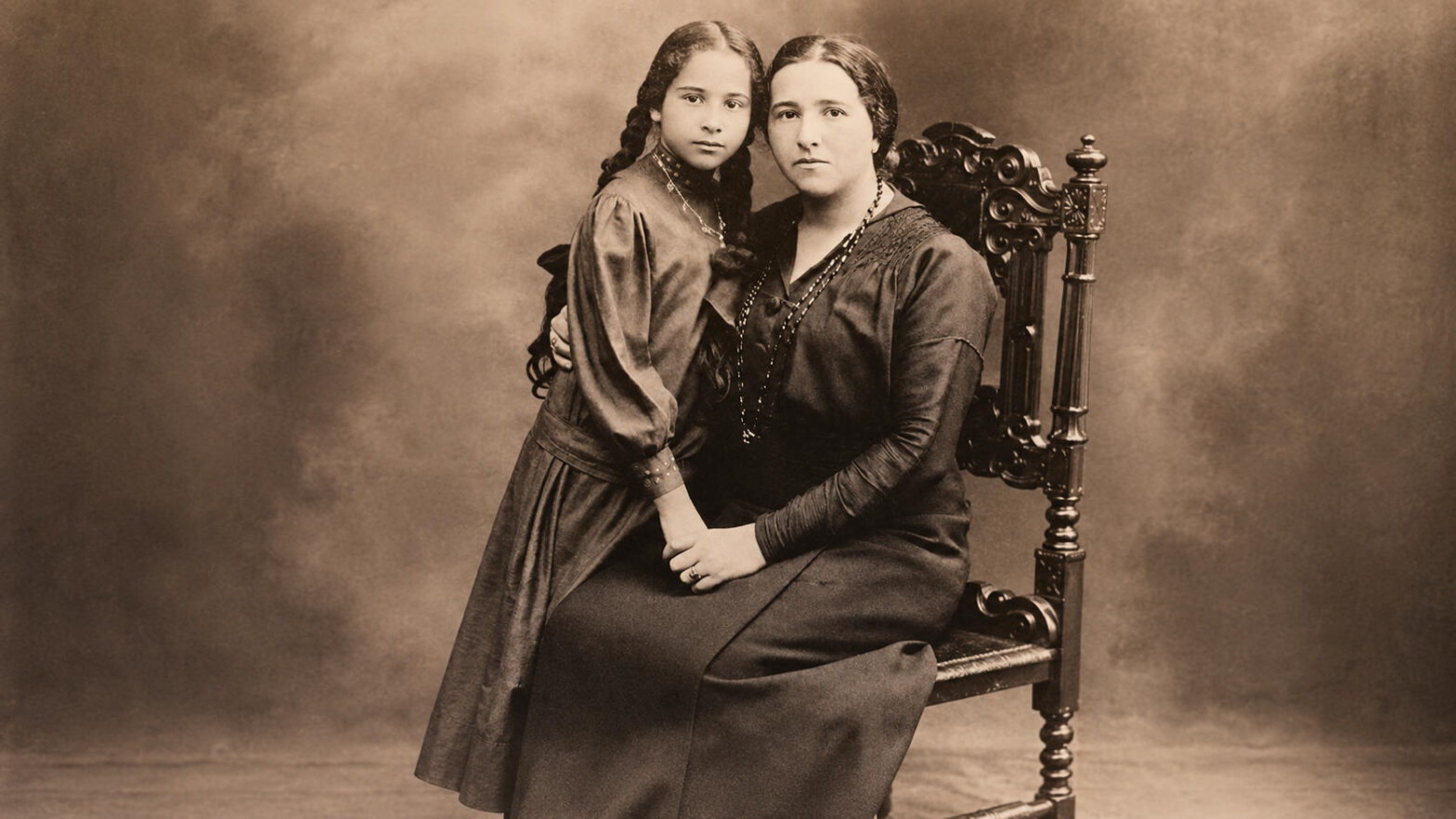
Moon Firdaria: 14 October 1906 to 14 October 1915
Introduction
Hannah Arendt, one of the most influential political thinkers of the twentieth century, was born Johanna Arendt on 14 October 1906 in Linden, near Hanover. Her parents, Paul Arendt and Martha Cohn Arendt, belonged to an educated, socially established Jewish family from Königsberg in East Prussia.
For the birth chart, data source, and rectification by Doctor H, see Hannah Arendt – Rectification
In traditional astrology, the firdaria divide life into a sequence of planetary periods. During each period, one planet becomes the principal time-lord, bringing its natal condition, house placement, aspects, and rulerships into prominence.
Because Arendt was born at night, her firdaria sequence begins with the Moon. The Moon governed the first nine years of her life, from birth until 14 October 1915.
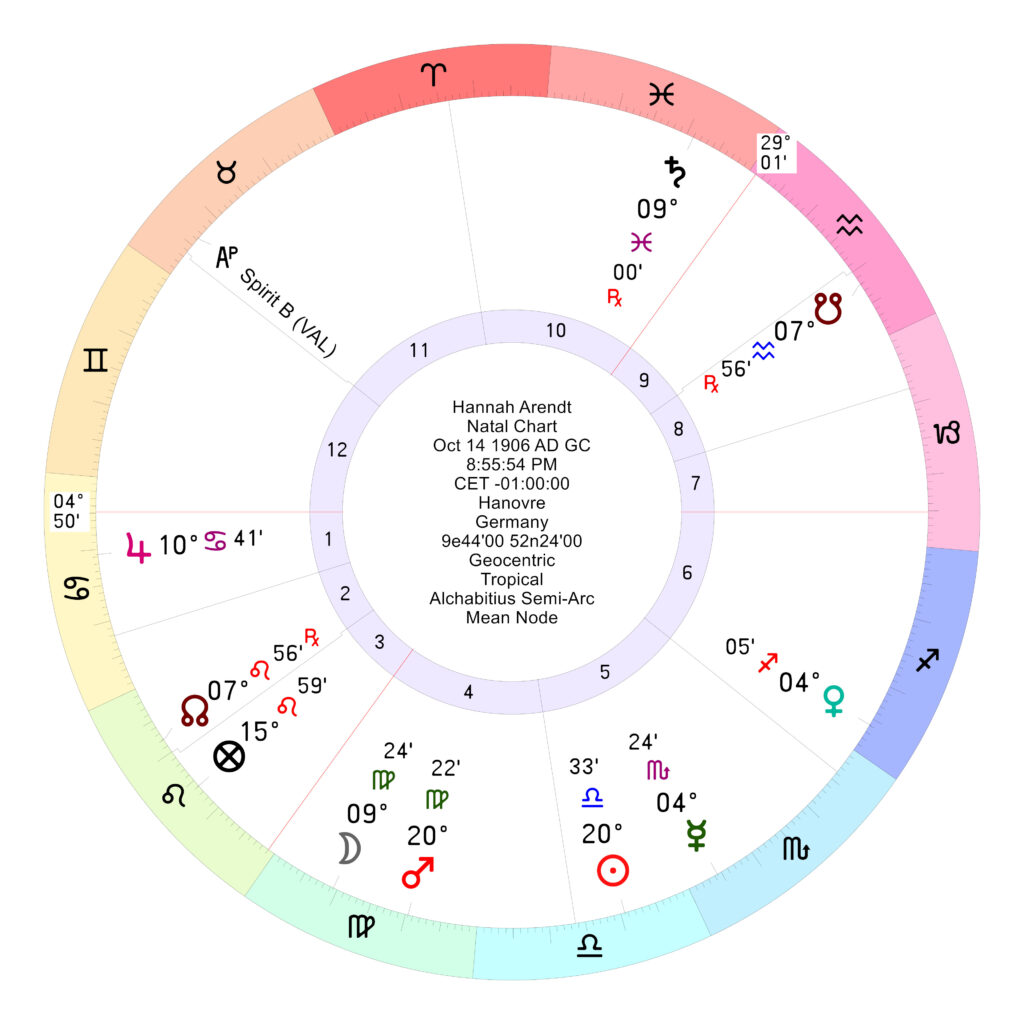
This is appropriate for a period covering infancy and early childhood. The Moon signifies the mother, the developing body, memory, habit, emotional formation, and the mind’s earliest impressions. In Arendt’s chart, the Moon is in Virgo in the third house, in the bound of Venus. It separates from a close opposition to retrograde Saturn in Pisces, applies to a close sextile with Jupiter in Cancer, and later applies to Mars in Virgo.
This sequence provides the structure of the period. Saturn describes illness, fear, decline, and bereavement near the beginning. Jupiter signifies education, protection, recovery, and growth. Mars brings physical strain, forced movement, disruption, and war.
The Moon as Mother, Body, and Early Mind
The Moon is the natural significator of the mother and the developing body. It also describes how a child receives the world before mature reason has formed.
Arendt’s Moon has several sources of strength. Because she was born at night, the Moon is the sect light and therefore holds greater authority in the chart. It also rules the earth triplicity in a nocturnal nativity, giving it essential dignity. In addition, the Moon rules the Ascendant and is placed in the third house, its traditional place of joy. The third house governs early learning, speech, writing, memory, relatives, short journeys, and the immediate environment.
Virgo adds observation, discrimination, order, and careful measurement. A Virgo Moon does not merely receive impressions. It sorts, compares, and tries to understand them.
This symbolism appears vividly in the record of Arendt’s early life. From the day of her birth, Martha began a notebook called Unser Kind, or Our Child. She recorded Hannah’s weight, feeding, sleep, health, first smile, speech, temperament, illnesses, fears, and intellectual development. The child’s growth became a text that the mother observed and interpreted: the Moon signifies the mother, Virgo measures and records, and the third house turns experience into words.
Martha followed the German ideal of Bildung, the deliberate formation of mind, body, and character. Hannah was not simply expected to gather information. She was taught discipline, responsibility, self-command, and the need to meet the demands of the day.
The household was progressive, secular, and intellectually rich. Her parents were assimilated Reform Jews with Social Democratic sympathies. Martha had studied music in Paris, while Paul was an engineer with a strong interest in classical literature. These conditions gave Hannah a protected beginning, although her childhood soon became marked by illness and loss.
A Precocious and Sensitive Child
Martha described Hannah as quiet, alert, cheerful, and affectionate. Her parents called her a ‘sunshine child.’ She enjoyed company, formed attachments easily, and responded well to kindness, although she could also display a quick temper.
Her language developed early. As a small child, she spoke in a private language of her own while understanding ordinary speech, especially when addressing her doll. She also repeated the warnings and commands she heard from adults. Language was therefore not merely practical; it became a private world, a form of play, and a way of arranging experience.
Hannah showed an exceptional memory, keen observation, and a strong sense of orientation. Mathematics later emerged as another strength. Manual and artistic skill were less obvious, but her ability to notice, retain, and understand was already pronounced.
In 1910, she began kindergarten in Königsberg. Her teachers soon recognized that she was intellectually ahead of many children her age, although her sensitivity sometimes made performance difficult. On her sixth birthday in October 1912, she received a marionette theatre. She prepared a play for her cousins but became so overwhelmed that she burst into tears.
The episode expresses both sides of the Virgo Moon: imagination, preparation, and the desire to perform well, but also nervousness, self-consciousness, and fear of failing to meet an inner standard.
The Moon’s placement in the bound of Venus softens Virgo’s analytical quality. Venus adds affection, beauty, music, poetry, and aesthetic sensitivity. These qualities appeared in Hannah’s responses to songs, flowers, ceremonies, and emotionally charged scenes.
The Moon Separating from Saturn
The central difficulty of the Moon firdaria is shown by the Moon’s separation from Saturn.
Saturn signifies illness, decline, fear, restriction, grief, isolation, and death. In Arendt’s chart it is retrograde in Pisces in the ninth house and connected to the Sun by antiscia. Since the Sun naturally signifies the father, this reinforces Saturn’s association with Paul Arendt’s long illness.
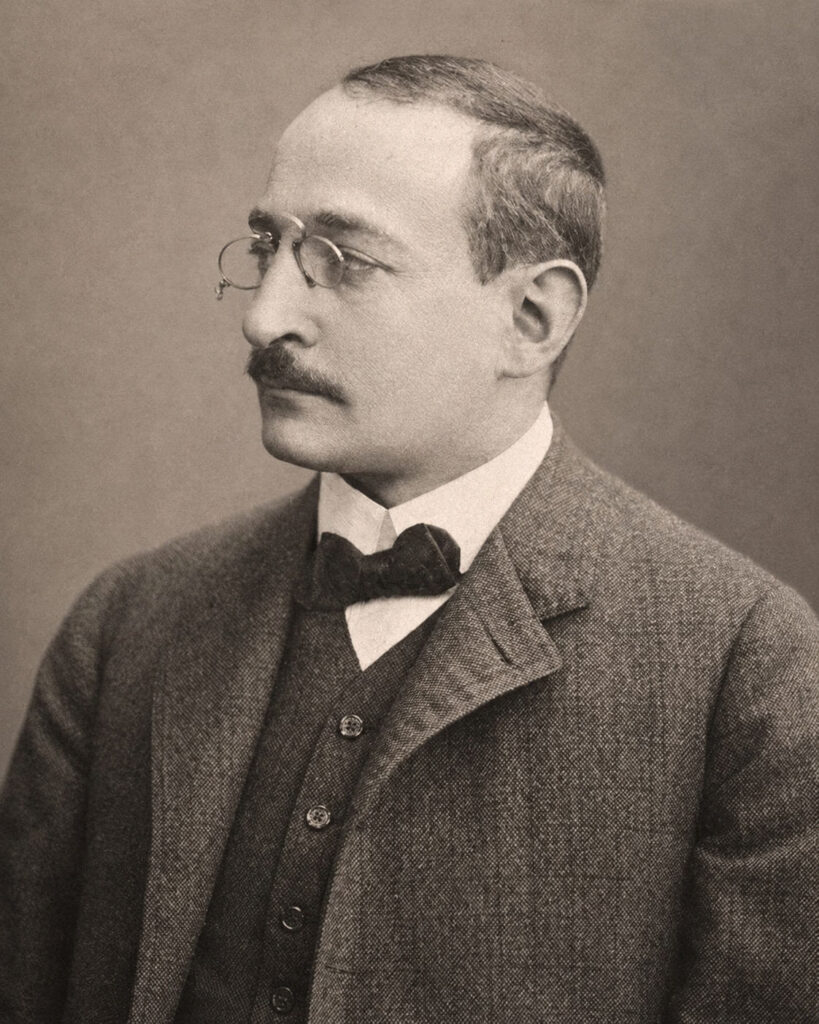
Paul had contracted syphilis years before Hannah’s birth. Although the disease was believed to have been treated, his health later deteriorated. In 1909, when Hannah was about three, the family left Linden and returned to Königsberg because his condition was worsening. They settled in the Hufen district at Tiergartenstraße 51, near Hannah’s paternal grandfather, Max Arendt.
By the summer of 1911, Paul’s illness had entered a severe tertiary stage. He suffered neurological and physical decline and was admitted to the Königsberg psychiatric hospital.
Hannah was only four, but she continued to visit him. Martha recorded that the child played cards with her father, prayed for him morning and night, and tried to shield him from harsh words. She showed patience and sympathy beyond her years. At other times, she wished that he were no longer there. This was not an absence of love, but the conflicted response of a child living under prolonged pressure. Love, pity, fear, and the wish for release existed together.
The Moon separating from Saturn describes this condition well. The child remains close to the burden, but she is also moving away from it. The experience becomes part of her emotional formation without becoming the Moon’s final destination.
Medical Fear and the Vulnerable Body
Paul’s illness also placed Hannah’s own body under suspicion. Because doctors feared that she might have inherited congenital syphilis, she underwent annual Wassermann blood tests for several years. Even when she appeared healthy, her body was repeatedly examined for signs of hidden disease.
This is another expression of the Moon opposed to Saturn. The Moon signifies the body and its changing conditions; Saturn brings fear, testing, restriction, and anxiety about chronic illness. Martha’s meticulous recording of symptoms, treatments, and recovery further emphasizes the Virgo Moon’s concern with observation and medical detail.
The pattern continued through childhood. Hannah suffered from mumps in 1913. Dental braces were fitted in November 1914 because of problems with her jaw and teeth. In March 1915, she endured high fever, cough, another bout of measles, mild whooping cough, and infections in both middle ears.
Both eardrums had to be pierced under anesthesia, and she remained ill for about ten weeks. Martha described the period as full of fear and worry. During illness, Hannah could become irritable, disobedient, and difficult. The cheerful ‘sunshine child’ was not always cheerful when pain and confinement overwhelmed her.
Yet she recovered. By the summer of 1915, she was again swimming at the seaside. Saturn shows vulnerability and fear; Jupiter, to which the Moon applies, shows the capacity to recover.
The Deaths of Grandfather and Father
The year 1913 brought two major losses.
On 18 March, Hannah’s paternal grandfather Max Arendt died. He had been a businessman, a Reform Jewish community leader, a local political figure, and a gifted storyteller. At the time of his death, Hannah was ill with mumps and watched the funeral procession from a window. Instead of openly expressing grief, she became absorbed in the flowers, the crowd, and the ceremony. She later said that one should not think too much about sad things.
Seven months later, on 30 October 1913, her father died after his long illness. Hannah was seven years old.
At his funeral, she again responded in an unexpected way. She tried to comfort her mother and reportedly cried mainly because of the beauty of the singing. She reminded Martha that such losses happened to many women.
These responses do not necessarily indicate an absence of feeling. They may show a child’s attempt to contain emotion by turning toward beauty, form, ceremony, and general truths. The Moon in Virgo processes emotion through observation. The bound of Venus responds to music, flowers, and beauty. Saturn restrains outward expression, while Jupiter seeks a wider meaning.
Martha sometimes felt that Hannah remained strangely ‘untouched.’ Yet the child had witnessed what her mother called the ‘entire horrible transformation’ of her father. Hannah’s outward composure may have served as protection. She learned early that grief could not always be repaired; it had to be endured, understood, or placed within a larger order.
The Moon Applying to Jupiter
The Moon does not remain with Saturn. It applies to a close sextile with Jupiter in Cancer.
Jupiter is the greater benefic, and its exaltation in Cancer strengthens its ability to signify protection, nourishment, education, growth, and guidance. Its sextile to the Moon is supportive rather than absolute: it does not remove every difficulty, but it helps create the conditions through which hardship can be endured and overcome. Jupiter is also in the Moon’s domicile, establishing a strong reception between the two planets and further reinforcing its capacity to support the Moon.
In Hannah’s early life, Jupiter’s support appeared through the stability, education, and care available after Paul’s decline and death. Martha assumed responsibility for raising her daughter, gave her a clear moral structure, encouraged intellectual independence, and remained closely attentive to her development.
Martha also prepared Hannah to face antisemitism. She instructed her that if a teacher made an antisemitic remark, she should leave the classroom and report it at home. Hannah was neither to argue nor to submit silently; the family would defend her dignity. This combination of protection and moral education fits Jupiter’s symbolism. Jupiter does not merely comfort. It teaches principles and sustains confidence in a larger order of justice.
In August 1913, Hannah entered the Szittnich School on Bahnstraße in Königsberg. She liked her teachers, especially Miss Jander, and was about a year ahead of many children her age. She also attended Sunday school enthusiastically and received Jewish religious instruction from Rabbi Hermann Vogelstein. Although the family was largely secular, Jewish identity remained part of her education and social world.
Jupiter did not erase Saturn. It gave Hannah the intellectual and emotional resources to continue beyond it.
Martha Arendt and the Virgo Moon
The relationship between Hannah and her mother deserves particular attention. During the Moon firdaria, Martha was the central figure in Hannah’s life: caregiver, educator, observer, moral guide, and protector.
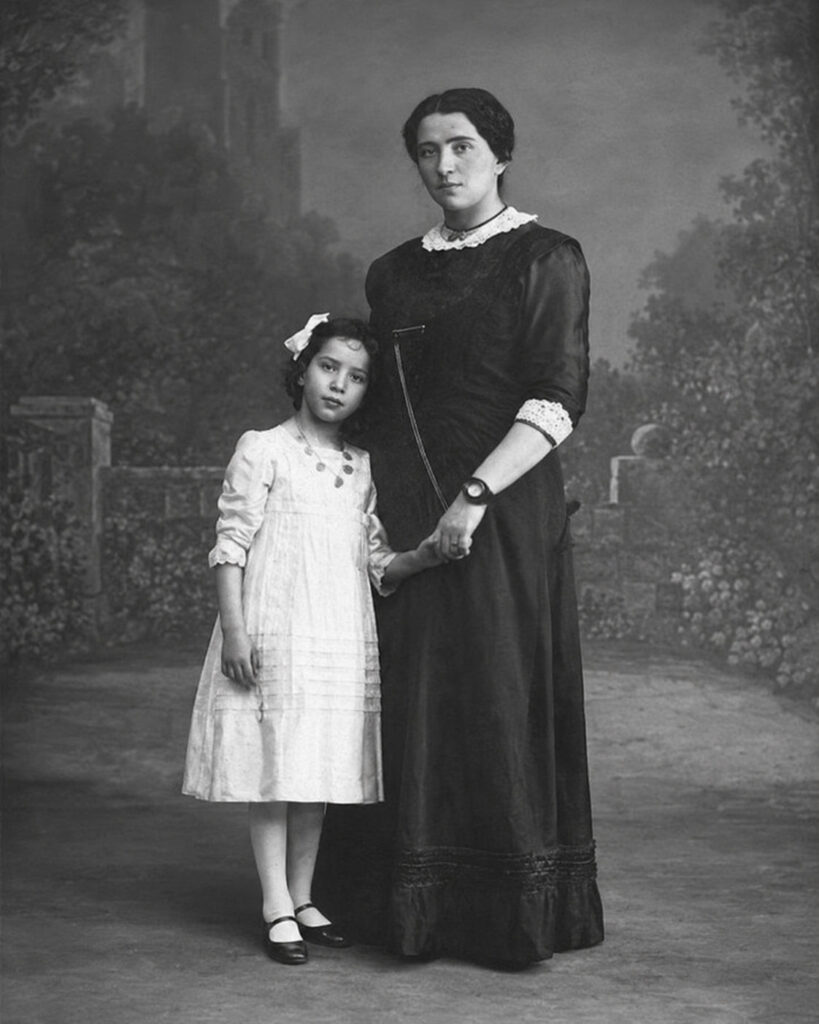
Her notebook reveals the intensity of this bond. She watched Hannah closely and measured her development against accepted standards. She worried about health, behavior, discipline, anxiety, and emotional response. At times, this care became excessive. Martha resolved to ‘see less’ and ‘disregard more,’ suggesting that constant observation could itself become a source of pressure.
Hannah was deeply attached to her mother and could suffer during separation or disruption. Emotional strain sometimes appeared through the body. Yet the same close attention also supported her remarkable development. Her curiosity was noticed, her ability encouraged, and her independence respected more than it might have been in a conventional household.
The Moon in Virgo therefore describes both gift and strain. Care becomes carefulness. Attention can become anxiety. Discipline produces growth, but it may also create nervousness.
By 1915, Hannah showed signs of school anxiety. Before tests, her knees sometimes gave way, and her written work did not always match her oral intelligence or broader ability. She knew more than she could consistently place on the page. The mind was powerful, but the body reacted strongly when tested.
The Application to Mars and the Disruption of War
After Jupiter, the Moon eventually applies to Mars in Virgo in the third house.
Mars signifies conflict, danger, heat, sudden movement, separation, and physical strain. In the third house, it can disturb travel, schooling, relatives, and the immediate environment. The clearest manifestation came with the outbreak of the First World War.
On 23 August 1914, as Russian forces advanced into East Prussia, Martha and Hannah fled Königsberg for Berlin. Trains were crowded, rumors circulated about destroyed villages, and panic spread through the population.
They stayed with Martha’s sister Margarethe Fürst and her three children. Hannah attended a girls’ Lyceum in Berlin-Charlottenburg and performed well despite being placed in an advanced class, but she remained homesick.
After about ten weeks, when the immediate Russian threat had receded, they returned to Königsberg. The displacement was brief, but it introduced Hannah to forced movement, wartime fear, and the sudden loss of home.
The third house had first appeared through language, relatives, school, and daily learning. Under Mars, the same house became the field of emergency travel, displacement, and interrupted education. Mars also appears in the physical crises of 1915 through fever, infection, painful procedures, and irritation. Once again, Jupiter’s strong condition supported recovery.
Notable Primary Directions
Primary directions are among the oldest timing methods in traditional astrology. They use the apparent daily rotation of the heavens after birth to bring planets and chart points into contact by direction.
In Arendt’s chart, the Moon is at 9° Virgo and Mars at 20° Virgo, both in the third house. When the Moon and Mars meet by primary direction, their natal relationship becomes more active. The Moon signifies the body, early memory, emotional response, and childhood conditions. Mars adds heat, urgency, conflict, pain, separation, and sudden action. In the third house, their contact can affect schooling, short journeys, relatives, the immediate environment, and the body’s response to stress.
Using the Moon’s full latitude and calculating by both the Regiomontanus and Placidus or Ptolemaic methods, the following Moon-Mars contacts occur during the later years of the Moon firdaria:
26-Sep-1912 REG Moon(l=p) c. → Mars
18-Aug-1913 REG Moon(l=p) c. → Mars(l=p)
08-Nov-1913 REG Mars d. → Moon(l=p)
27-Nov-1913 PT Moon(l=p) c. → Mars
30-Aug-1914 PT Moon(l=p) c. → Mars(l=p)
11-Sep-1914 REG Mars(l=p) d. → Moon(l=p)
24-Sep-1914 PT Mars d. → Moon(l=p)
04-Jun-1915 PT Mars(l=p) d. → Moon(l=p)
The significance of these directions lies in the clusters they form around the most difficult periods of Arendt’s childhood.
The first cluster extends from September 1912 through November 1913 and surrounds the deaths of her grandfather and father. The direction of 26 September 1912 preceded Max Arendt’s death on 18 March 1913. The contact of 18 August 1913 occurred shortly before Paul Arendt’s death on 30 October, followed by two further directions in November during the immediate aftermath.
Mars can signify rupture, severance, and acute strain. Joined with the Moon, it may also describe the body’s and nervous system’s response to events that a child cannot control. The timing therefore corresponds with repeated loss, Martha’s grief, and the collapse of the family structure Hannah had known.
The second and clearest cluster occurred in late summer and early autumn 1914. Hannah and her mother fled Königsberg on 23 August. Primary directions followed on 30 August, 11 September, and 24 September. These contacts closely surround the flight and temporary displacement. Mars in the third house describes sudden movement, dangerous travel, interrupted schooling, and disturbance in the immediate environment. The Moon brings in the child, the mother, domestic routine, and the need for safety.
The final direction, on 4 June 1915, falls near the end of a serious medical crisis. Beginning in March, Hannah suffered fever, measles, mild whooping cough, and infections in both ears. Both eardrums were pierced under anesthesia, and she remained ill for about ten weeks. A further fever followed a school outing around Whitsun. Moon-Mars directions frequently coincide with heat, inflammation, pain, treatment, exhaustion, or an acute bodily response to stress. The June contact therefore corresponds with the closing phase of this illness and her gradual recovery.
Taken together, the directions sharpen the pattern already shown by the firdaria. The Moon’s application to Mars was not merely a natal promise. It became active during periods of bereavement, displacement, and illness. The same third-house Moon that supported observation, study, and careful development also became vulnerable to Martian interruption.
The Formation of an Observant Mind
The first nine years of Hannah Arendt’s life combined exceptional care with severe hardship. She was born into a loving, educated household and had access to books, stories, music, teachers, and a mother deeply committed to her development. Yet she also witnessed her father’s long decline, lost her grandfather and father within the same year, underwent repeated medical testing, endured painful illness, and experienced wartime displacement.
The Moon’s sequence describes these years with unusual coherence. Its separation from Saturn signifies the burden near the beginning of life: illness, fear, grief, vigilance, and the early discovery that some losses cannot be repaired. Its application to Jupiter signifies education, protection, recovery, and growth. Despite hardship, Hannah continued to learn, advanced in school, recovered from illness, and returned home after displacement. Its later application to Mars shows that this growth did not take place in peace. War disturbed her surroundings, travel and schooling were interrupted, and the body became vulnerable to fever, infection, and painful treatment.
By the end of the Moon firdaria in October 1915, the foundations of Arendt’s later mind were already visible. She had learned that bodies are fragile, homes can be lost, and death can enter ordinary life without warning. She had also learned that attention, education, and judgment can preserve a measure of order when events themselves cannot be undone.
This tension between beginning and mortality later became central to Arendt’s thought, especially her idea of natality, the human capacity to bring something new into the world. Her early life does not fully explain this concept, but it provides an important context: she was born into a household marked by illness and loss, yet she continued to learn, recover, and begin again. The Moon firdaria formed her through vulnerability and resilience. Saturn brought suffering, Jupiter supported growth, Mars introduced rupture, and Virgo cultivated the habits of attention, memory, and judgment that would later shape her intellectual life.