
14 October 1945 to 13 October 1950
After the Mars firdaria of war, internment, escape, and forced migration, Hannah Arendt entered a different five-year period. The first three years belonged to the North Node, from 14 October 1945 to 13 October 1948. The following two years belonged to the South Node, from 14 October 1948 to 13 October 1950.
Together, these nodal years carried Arendt from the immediate experience of catastrophe toward the intellectual work that would become The Origins of Totalitarianism.
In traditional astrology, the lunar nodes do not act like ordinary planets. They function as a pair. The North Node tends to increase, amplify, and bring forward the topics of its place, while the South Node tends toward decrease, separation, loss, and return. Their effects depend on their signs, houses, bounds, and planetary rulers.
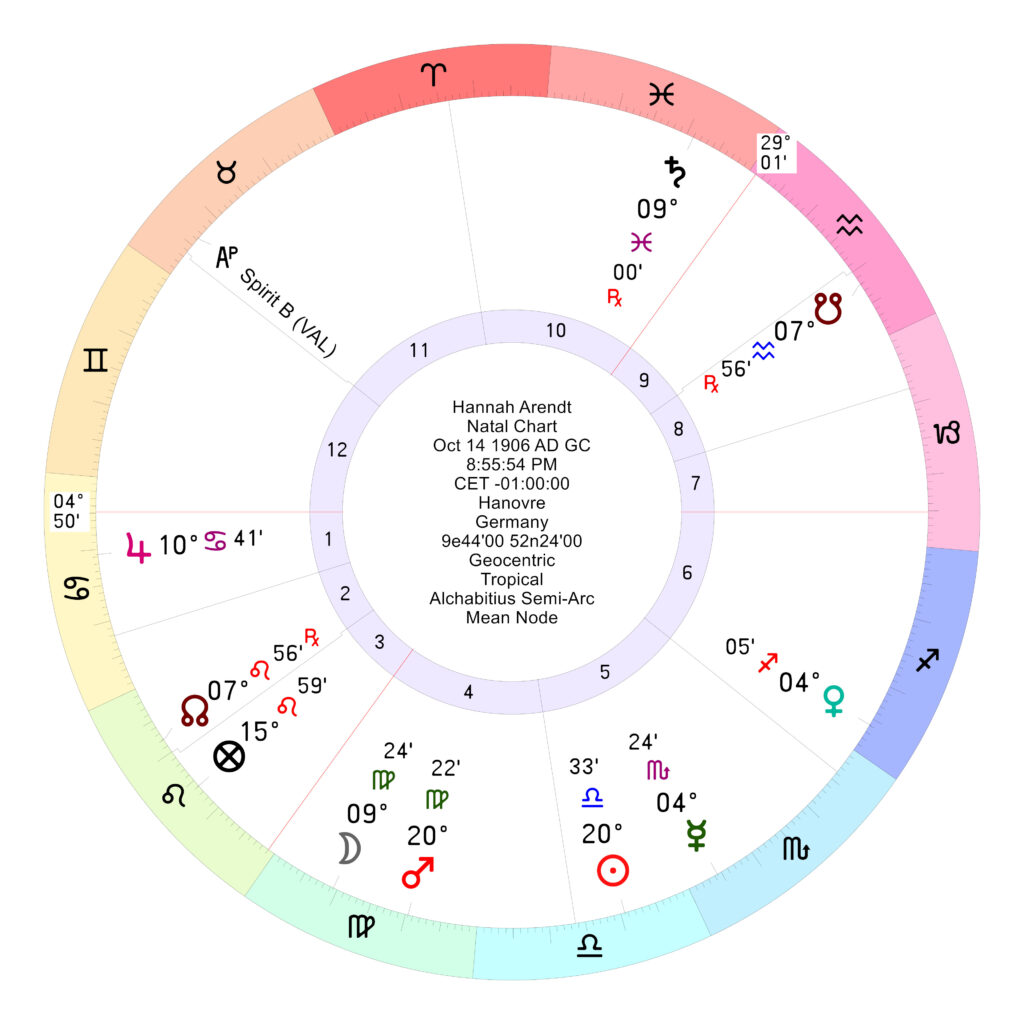
Arendt’s nodal axis is especially significant. The North Node is in Leo in the second house, in the bound of Venus. The South Node is in Aquarius in the eighth house, also in the bound of Venus. Her Lot of Fortune is likewise in Leo, but in the bound of Saturn. The Sun rules the North Node from Libra in the fourth house (whole sign), while Saturn rules the South Node from Pisces in the ninth (whole sign).
This creates a powerful second–eighth house axis involving resources and loss, survival and destruction, emergence and descent. During the nodal firdaria, these themes became visible in both Arendt’s circumstances and her intellectual work.
The Second and Eighth Houses: The Gates of Hades
Ancient astrology associated the second and eighth houses with the Gates of Hades.
The eighth house is connected with death, loss, fear, the resources of others, and conditions that remove a person from ordinary control over life. The second house stands opposite it and concerns livelihood, possessions, resources, and the means that sustain life. Within this axis, the eighth house describes descent and loss, while the second can represent emergence and the rebuilding of material stability.
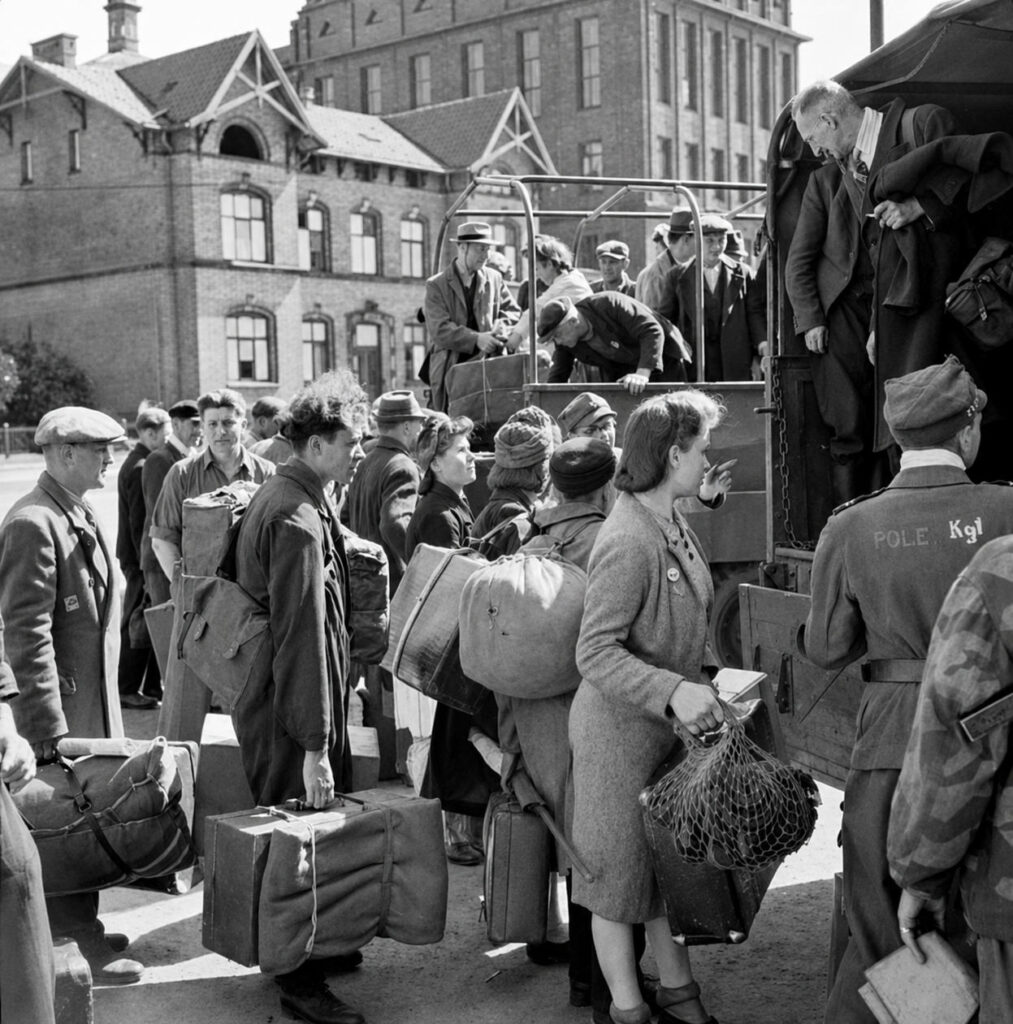
Arendt entered the nodal period having already experienced the darker side of this axis. She had lost German citizenship, endured exile and internment, escaped from France, and crossed the Atlantic as a stateless refugee. She had experienced political exclusion and the collapse of normal legal protection firsthand.
By October 1945, however, she was no longer simply trying to survive these experiences. During the North Node period, they increasingly became intellectual material. The movement was not simply from misfortune to good fortune, but from experience toward understanding.
With the North Node in the second house, Arendt began bringing what she had learned from the eighth-house world of loss and exclusion into public form. The catastrophe of the previous decade would become the material from which she developed a broader theory of political domination.
The North Node Firdaria
14 October 1945 to 13 October 1948
Increase, Visibility, and a Major Work
The North Node is in Leo in Arendt’s second house.
The second house concerns income, possessions, resources, livelihood, and the means by which a person supports life. With the North Node here, these topics were amplified during the period.
Arendt became increasingly established as a writer, editor, and intellectual. She moved further into professional publishing and began earning more of her livelihood through intellectual work.
In September 1946, she prepared a formal publishing memorandum for what she then called the “imperialism book.” The following month, she signed a contract with Houghton Mifflin. By December, the agreement had been formally processed.
The project would eventually become The Origins of Totalitarianism.
The North Node in the second house therefore coincided with an expansion of professional resources through the very work that would later establish Arendt’s international reputation.
The Lot of Fortune adds another layer. It is also in Leo, but in the bound of Saturn.
Saturn in Leo carries the symbolism of organized power constraining the solar principles of individuality, visibility, and personal dignity. This resonates with one of Arendt’s central concerns in The Origins of Totalitarianism: the destruction of individuality under total domination.
Her livelihood and future reputation were becoming tied to the study of political systems capable of reducing human beings to something interchangeable and expendable.
The Genesis of Totalitarianism
Between 1945 and 1948, Arendt gradually developed the architecture of her theory of totalitarianism.
The Holocaust had revealed a scale of organized destruction that older categories such as tyranny and dictatorship seemed inadequate to explain. Soviet domination in Eastern Europe also convinced her that the problem could not be reduced to German Nazism alone.
She began searching for a broader political structure capable of accounting for both systems.
Her own experience provided an important background. Arendt had already lived through some of the preliminary stages of political exclusion: loss of citizenship, statelessness, classification as an enemy alien, internment, and the disappearance of ordinary legal protection.
Now she turned toward the concentration camps and the political machinery that had carried these processes to their extreme conclusion.
Several essays show her argument developing.
In September 1946, she published “The Image of Hell,” confronting the inadequacy of ordinary moral and legal categories when applied to the death camps. The camps appeared not simply as places where governments killed enemies, but as institutions that had moved beyond ordinary political utility.
A month later, in “Expansion and the Philosophy of Power,” she turned toward nineteenth-century imperialism. She examined unlimited expansion and the way imperial administration allowed power to escape the restrictions of ordinary law.
In July 1947 came “The Hole of Oblivion.” Here Arendt emphasized that total domination sought more than physical destruction. It attempted to remove people from memory, history, and shared reality.
Then, in July 1948, she published “The Concentration Camps.” The camps now appeared as laboratories of total domination, aimed at destroying legal identity, moral independence, individuality, and ultimately human spontaneity.
By the end of the North Node firdaria, the main elements of her theory were taking recognizable form.
Venus and Cultural Preservation
The North Node is in the bound of Venus, linking the period with literature, culture, relationships, and things considered valuable.
In July 1946, Arendt became chief editor at Schocken Books in New York. The publishing house played an important role in bringing European Jewish literature and scholarship into the English-speaking world.
At the same time, her earlier work in Jewish cultural reconstruction continued to develop. In 1946, her research staff produced the Tentative List of Jewish Cultural Treasures in Axis-Occupied Countries and a corresponding list of Jewish educational institutions.
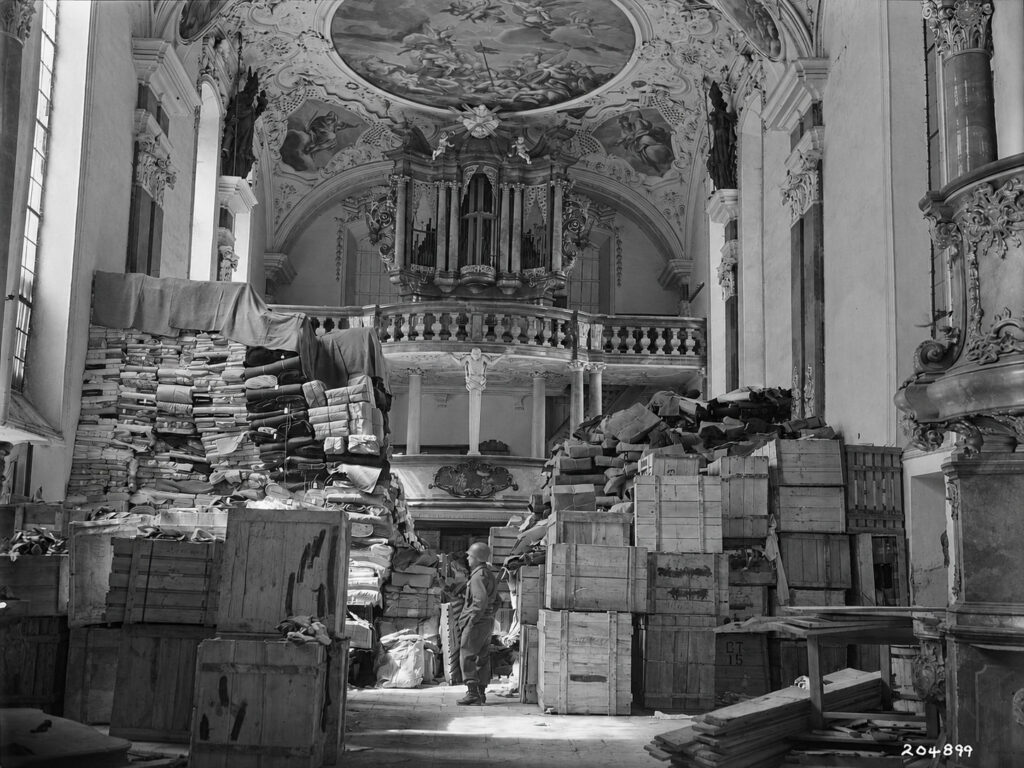
These inventories recorded what had existed, what had been stolen, and what might still be recovered.
The North Node in the bound of Venus therefore describes more than financial expansion. It also connects the period with cultural preservation.
Arendt worked as editor, researcher, and intellectual mediator, helping preserve texts and traditions that the destruction of European Jewish life had placed in danger.
Reconnecting with Karl Jaspers
Late in 1945, Arendt re-established correspondence with Karl Jaspers after years of wartime separation.
Their renewed exchange became one of the most important intellectual relationships of her postwar life. They discussed German responsibility, guilt, political judgment, and the moral consequences of the catastrophe.
The connection also fits the rulership of the North Node.
Its ruler, the Sun, is in Libra in Arendt’s fourth house. The fourth house brings questions of homeland, origins, roots, and belonging into the period.
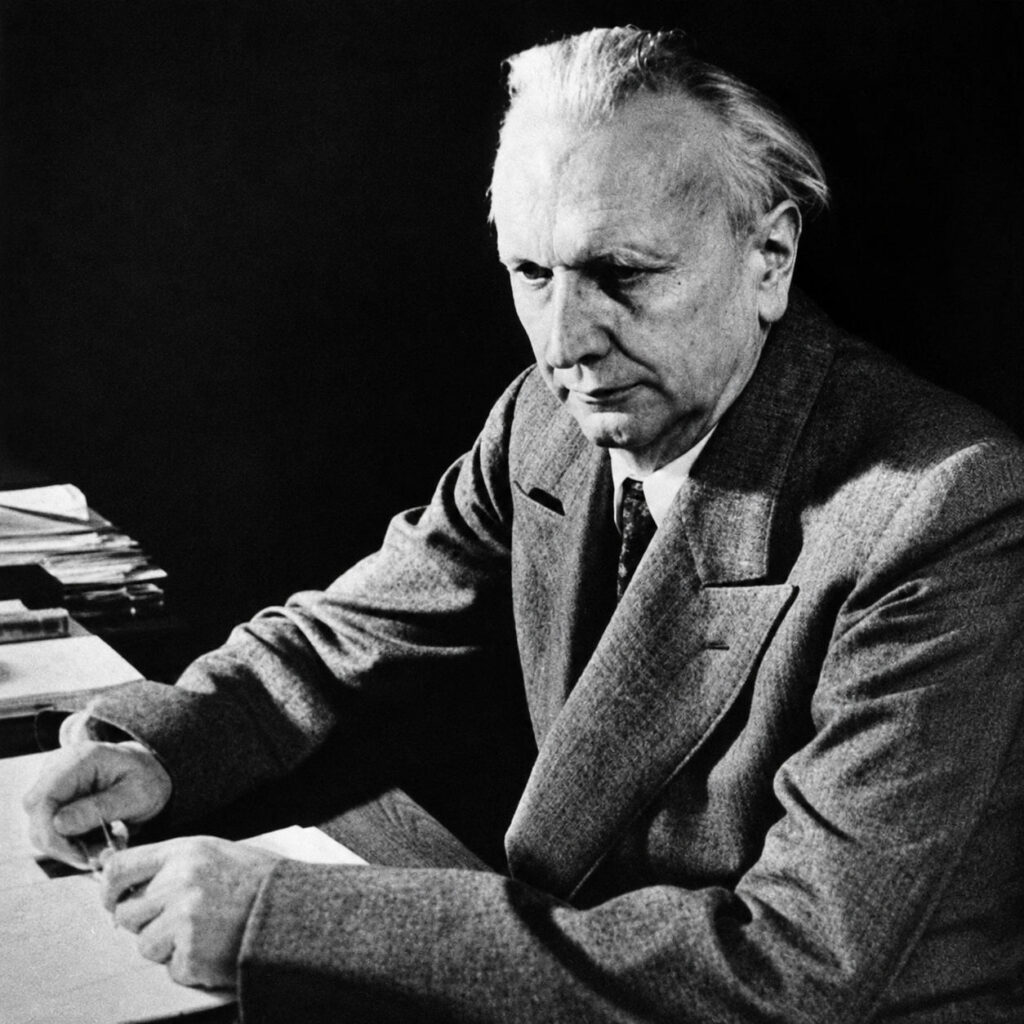
Even as Arendt established herself in America, her intellectual attention repeatedly returned to Germany and to the philosophical world in which she had been formed.
Jaspers became one important bridge back to that world.
The Zionist Rupture and the Monster of Nationalism
The North Node period also brought increasing tension between Arendt and mainstream Zionism.
She had worked actively within Zionist organizations during the 1930s and had helped young Jewish refugees reach Palestine. After the destruction of European Jewry, however, her political thinking changed.
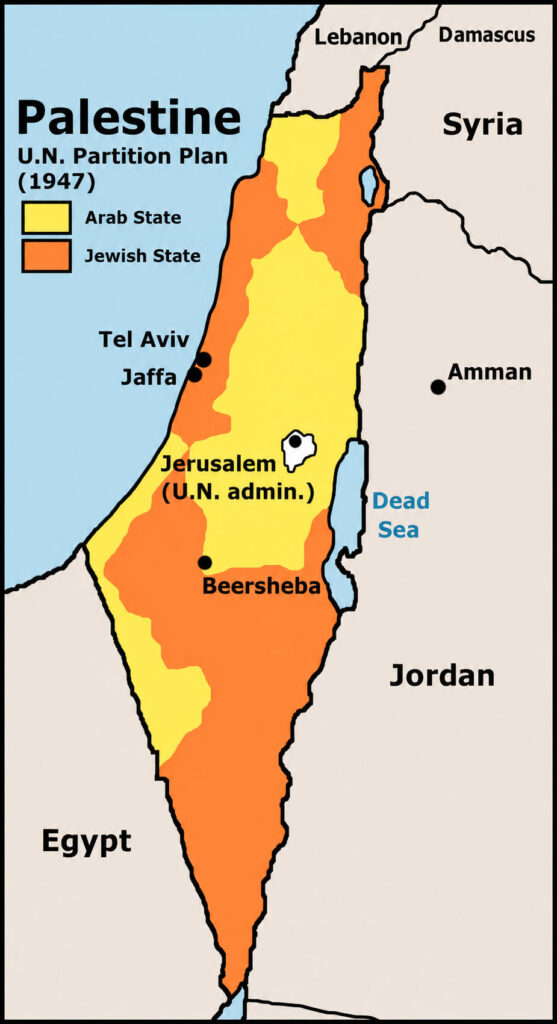
Arendt became increasingly skeptical that political security could be secured simply by creating another sovereign nation-state organized primarily around national identity. Her concern was closely related to the questions emerging elsewhere in her work: what happens to minorities when political rights depend too heavily upon membership in a dominant national group?
In “The Jewish State: Fifty Years After” in 1946, “Jewish History, Revised” in 1948, and “To Save the Jewish Homeland: There Is Still Time” in May 1948, she argued for binational or federal arrangements between Jews and Arabs rather than exclusive national sovereignty. These positions increasingly separated her from mainstream Zionist leadership.
This rupture also returns us to the Saturn–Leo symbolism. Saturn in Leo describes organized power constraining the solar principles of individuality, dignity, and self-expression. Arendt increasingly saw the modern nation-state as capable of becoming an impersonal political machine in which the rights of the individual depended upon membership in the dominant national group.
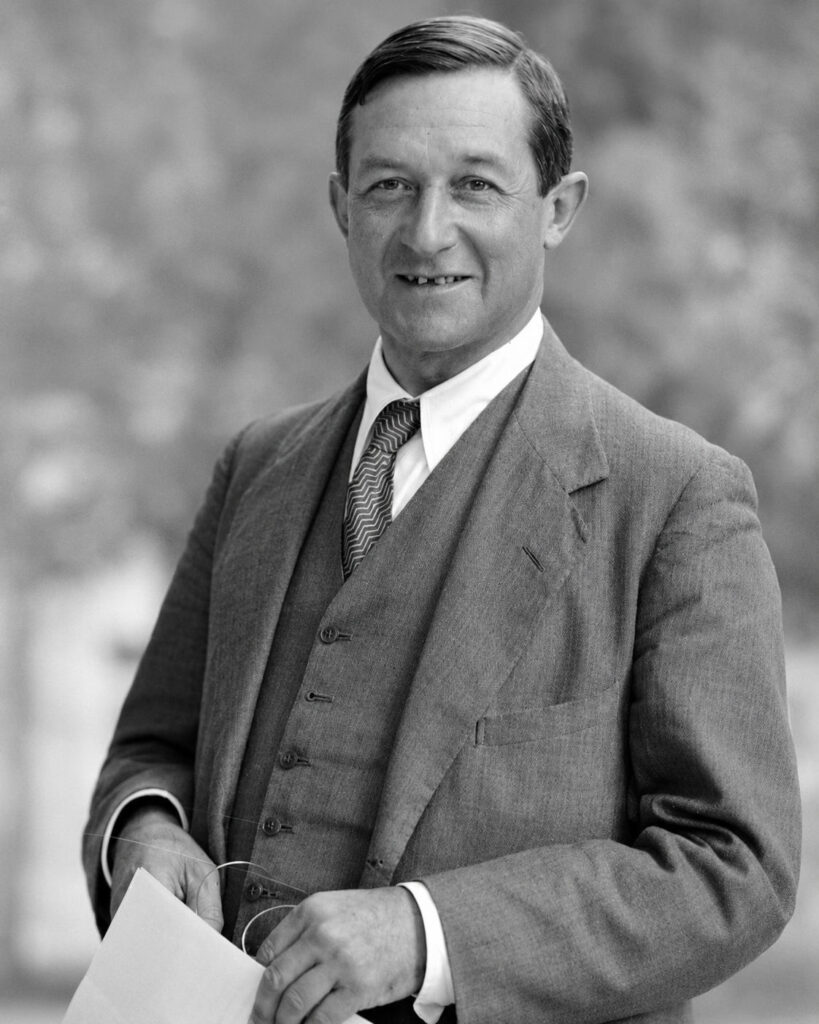
A useful parallel appears in Rabindranath Tagore, who has Jupiter in the bound of Saturn/Leo in his birth chart. Tagore famously criticized the modern nation-state as a vast, mechanical form of organized power. Arendt approached the problem from a different historical experience, but she arrived at a related concern: nationalism could create political structures that marginalize minorities and produce new populations of refugees and stateless people.
Her objection was therefore not merely to nationalism as an abstract doctrine. It concerned the political fate of those who stood outside the majority.
The question was becoming central to her work: Who belongs to the political community, and what happens to those who do not?
The South Node Firdaria
14 October 1948 to 13 October 1950
In October 1948, the emphasis shifted.
The South Node occupies Aquarius in Arendt’s eighth house, again in the bound of Venus. If the North Node period had emphasized expansion and emergence, the South Node turned her attention more directly toward loss, recovery, completion, and the past.
Arendt returned physically to Europe, surveyed the cultural ruins left by Nazism, completed the manuscript that had grown from those experiences, and reunited with important figures from her intellectual youth.
The South Node did not stop her intellectual development. It concentrated it.
Completing The Origins of Totalitarianism
By the autumn of 1949, Arendt had completed the manuscript of The Origins of Totalitarianism.
Several publications from these years show the final structure of the argument taking shape.
In January 1949, “Totalitarian Terror” examined terror not simply as a weapon used against political opponents but as a permanent principle of totalitarian government.
That same year, “The Rights of Man: What Are They?” developed one of Arendt’s most enduring arguments.

The experience of stateless people had exposed a fundamental weakness in abstract declarations of universal rights. A person might theoretically possess rights simply by being human, yet lack any political community capable of recognizing or enforcing them.
This problem would later be summarized through the idea of the “right to have rights”: meaningful rights first require membership in a political world where a person’s speech and actions can be recognized.
The South Node in Aquarius in the eighth house provides an appropriate symbolic setting. Aquarius brings collective and political questions, while the eighth house reveals what happens when ordinary protections and securities disappear.
Arendt’s argument emerged from the condition of people who had lost precisely those protections.
The Camps and the “Hole of Oblivion”
In January 1950, Arendt published “Social Science Techniques and the Study of Concentration Camps.”
She argued that ordinary academic categories could fail when confronted with genuinely unprecedented political phenomena.
In her developing theory, the camps were not simply harsher prisons. They represented an attempt to remove people from ordinary human reality.
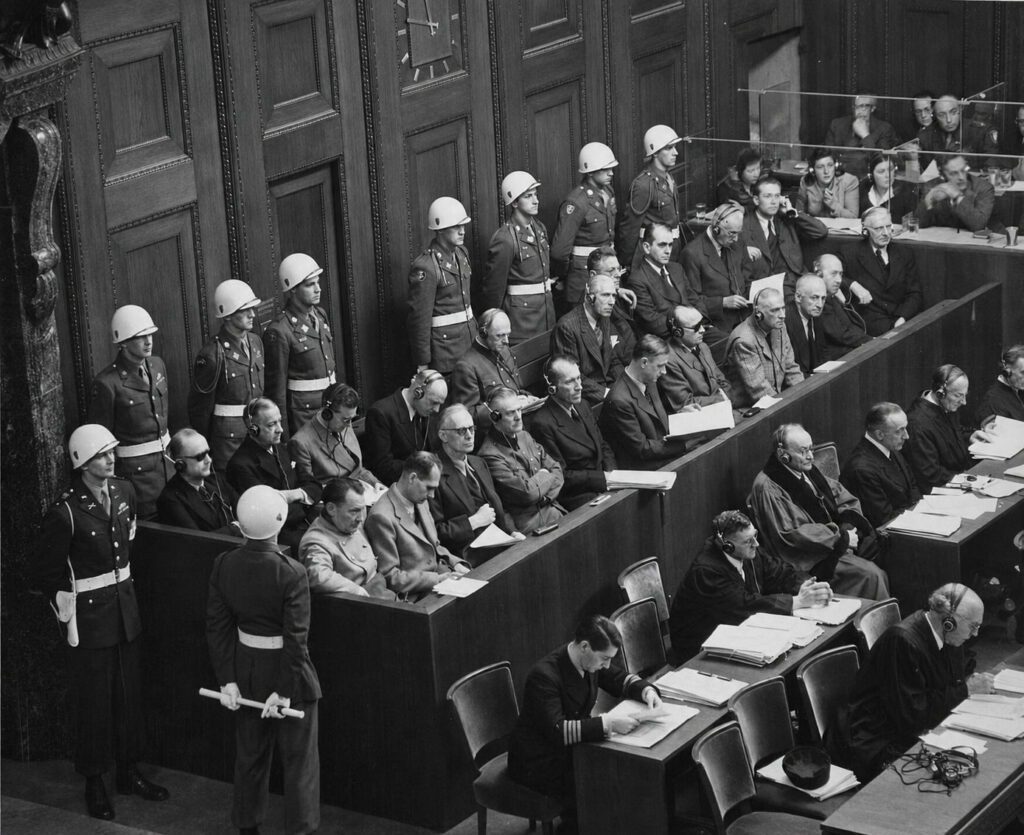
This makes the image of the “hole of oblivion” especially appropriate to the South Node in the eighth house. The South Node has a weakening, draining, and concentrating influence, almost like a black hole drawing things inward and diminishing what remains. The eighth house is associated with death and loss.
Arendt was examining political systems that sought not only to kill individuals but to erase their legal identity, memory, and place within the human world.
Return to the Ruins
The symbolism became more concrete through Arendt’s work with Jewish Cultural Reconstruction, Inc.
In February 1949, JCR was appointed trustee for heirless Jewish cultural property in the American occupation zone of Germany. In August, Arendt became executive director.
Late that year, she travelled to Europe for the first time since her escape in 1941.
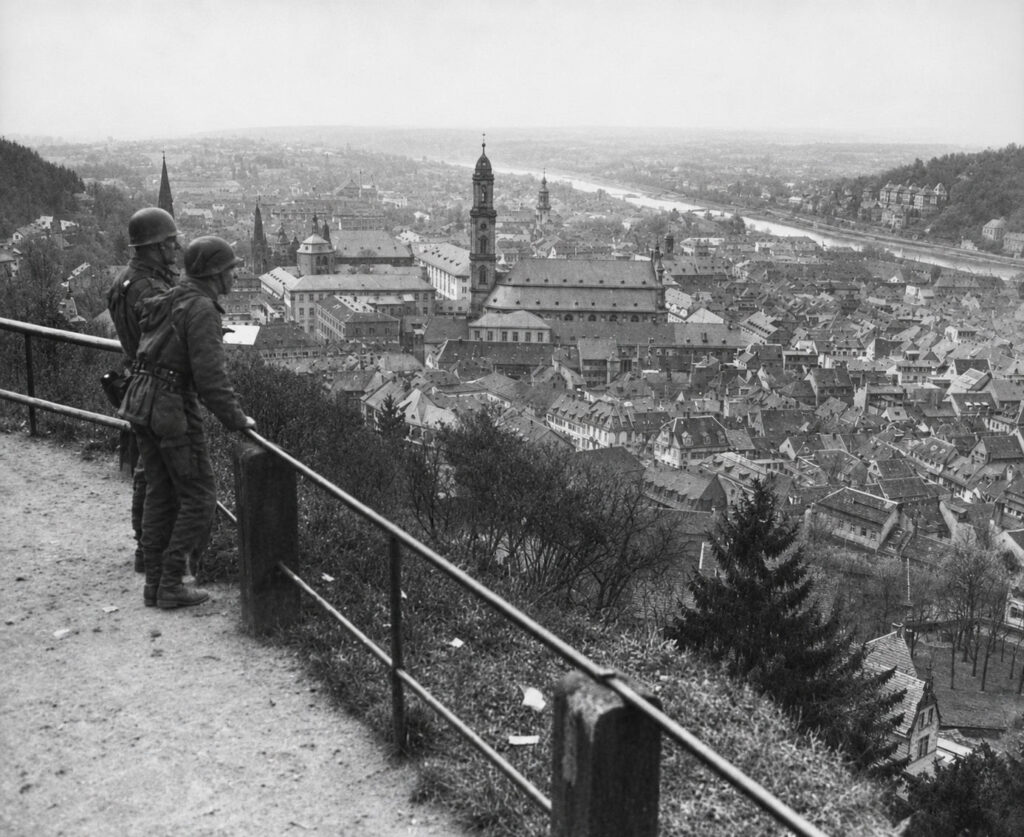
Her work took her through the devastated German landscape, where she inspected libraries, archives, books, Torah scrolls, ritual objects, and other cultural property whose owners had often been murdered.
Between February and March 1950, she conducted a detailed survey of surviving Jewish cultural assets. The results were later presented in Field Report No. 18.
The eighth-house symbolism is difficult to miss.
Arendt returned to a landscape defined by absence. Her task was to identify and document what remained.
Saturn and Documenting the Void
The South Node is ruled by Saturn.
Arendt’s Saturn is retrograde in Pisces in the ninth house. Following the retrograde principle used in this analysis, Saturn in Pisces can take on Virgo-like qualities of examination, classification, discrimination, and careful organization.
These themes closely resemble her work with Jewish Cultural Reconstruction.
The ninth house adds foreign travel, scholarship, religion, cultural tradition, and questions of meaning. Arendt travelled through Europe while cataloguing the remnants of an intellectual and religious world.
The work was administrative, but its implications were larger.
The Nazis had attempted to erase Jewish culture from European life. By identifying books, archives, and ritual objects, Arendt participated in preventing that disappearance from becoming complete.
Venus and Cultural Survival
The South Node, like the North Node, is in the bound of Venus. This creates an important continuity across the entire nodal firdaria.
During the North Node years, Venus appeared through publishing, editing, literature, and the preservation of Jewish cultural treasures.
Under the South Node, the same themes moved into the eighth house. Preservation became recovery from loss.
Arendt was no longer only publishing the surviving intellectual heritage of European Judaism. She was helping retrieve its scattered physical remains.
Her 1949 essay “The Achievement of Hermann Broch” belongs to the same pattern. Even while working among damaged institutions and orphaned collections, she continued drawing attention to European writers whose intellectual lives had survived persecution and exile.
Culture became one answer to oblivion.
The Ghosts of the Past: Jaspers and Heidegger
The South Node period also brought back two figures from Arendt’s Saturn firdaria: Karl Jaspers and Martin Heidegger.
Both belonged to her intellectual formation in the 1920s, and both re-entered her life as she physically returned to Europe. This fits the rulership of the South Node by Saturn, which is retrograde in the ninth house of philosophy, higher learning, and teachers.
During the winter of 1949–1950, Arendt reunited with Jaspers in Basel. Their friendship deepened and would remain central to her later intellectual life. Then, on 7 February 1950, she met Heidegger again in Freiburg after seventeen years of separation. The following day, she met with Heidegger and his wife Elfride.
This reunion was far more complicated.
Heidegger had joined the Nazi Party in 1933 and served as rector of Freiburg University. Yet Arendt resumed contact with him.

Venus becomes relevant here. It rules the bound of the South Node and, from Sagittarius, overcomes Saturn in Pisces by a superior square. Venus can therefore introduce reconciliation and renewed connection into an otherwise difficult Saturnian situation.
Arendt’s renewed relationship with Heidegger fits this symbolism: a major figure from her philosophical past returned during an eighth-house South Node period, while Venus provided the possibility of restoring a broken connection.
Her relationships with Jaspers and Heidegger, however, remained very different.
Jaspers increasingly represented philosophical communication, responsibility, and engagement with the shared world. Heidegger presented a more troubling problem: extraordinary philosophical intelligence combined with catastrophic political judgment.
The contrast fed directly into Arendt’s continuing concern with the relationship between thinking and judgment.
Conclusion: Emergence and Return
The nodal firdaria moved Arendt through two related phases. The North Node brought her wartime experience into public and intellectual form; the South Node returned her to the losses from which that work had emerged.
Venus linked both periods through publishing, cultural preservation, recovery, and renewed relationships. By October 1950, The Origins of Totalitarianism was complete, Arendt had returned to Europe, and the central themes of her postwar thought were firmly established.
The next firdaria belongs to the Sun. What had been developed through exile, research, and reconstruction was ready to move into greater public visibility.