14 October 1950 to 14 October 1960
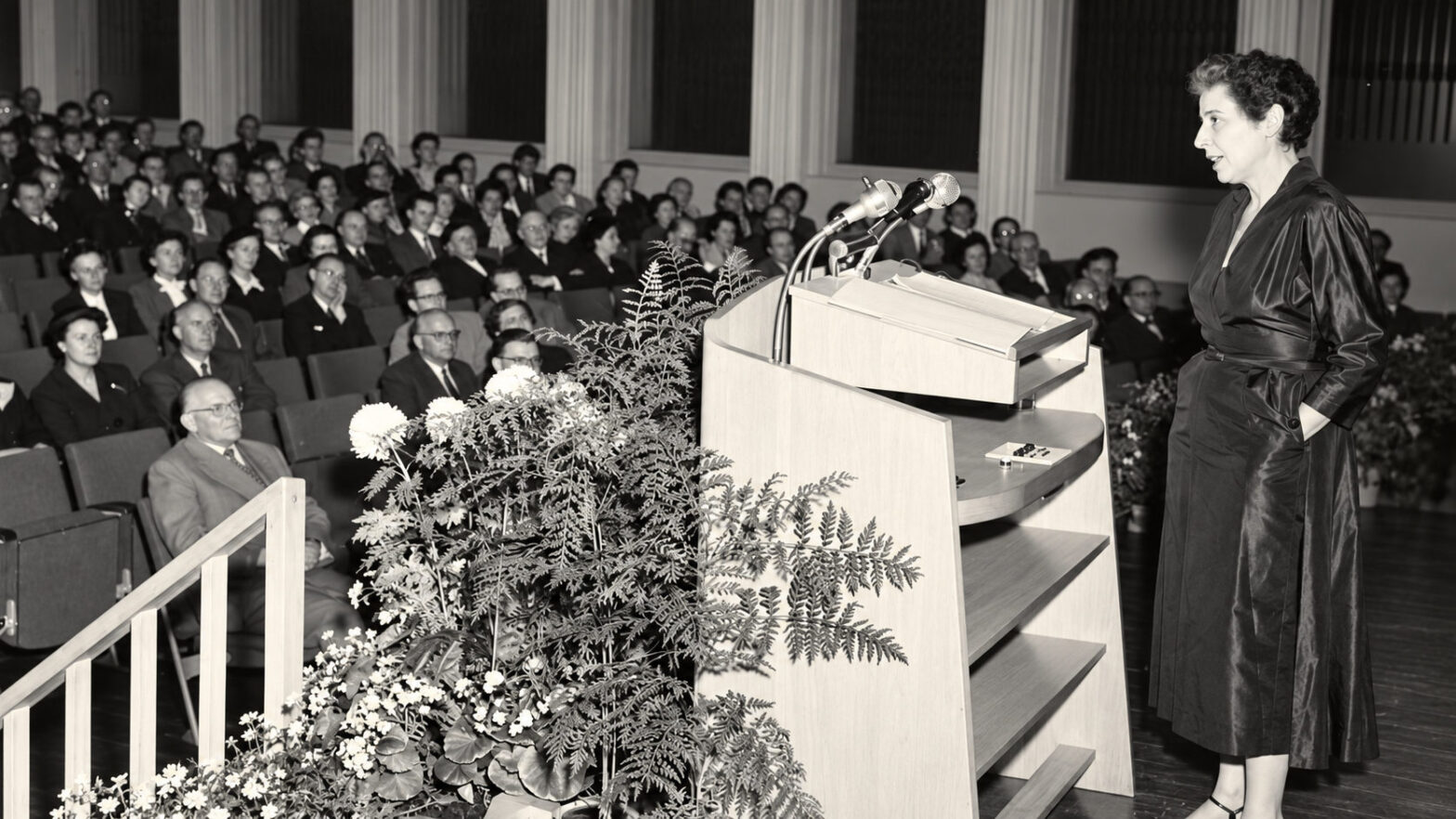
After years of exile, statelessness, and intellectual reconstruction, Hannah Arendt entered a decade of growing public recognition. Her Sun firdaria began on 14 October 1950, when she turned forty-four. Within ten years, she published The Origins of Totalitarianism and The Human Condition, became an American citizen, and established an international reputation as a political thinker.
The Sun signifies authority, reputation, distinction, and visibility. Yet in Arendt’s nocturnal chart, it is contrary to sect and in its fall in Libra. Its placement in Jupiter’s bound provides an important counterweight. This Jupiter/Libra combination favors intellectual expression and judgment, offering a key to the particular kind of recognition she received.
The Sun in Libra: The Authority of Thought
Arendt’s Sun occupies Libra in the fourth whole-sign house and fifth quadrant house. It is in Venus’s domicile and Jupiter’s bound. Libra is the sign of the Sun’s fall, which weakens its straightforward expression of command and personal authority. Yet its bound provides a different kind of support.
According to Doctor H‘s research, the bound ruler acts like a hidden conjunction. The Sun in Jupiter’s Libra bound can therefore be interpreted as though the Sun were conjunct Jupiter in Libra. The comparison is symbolic: Jupiter is not physically conjunct the Sun, nor is Jupiter actually in Libra. Rather, the bound brings out the constructive Jupiter/Libra qualities of balanced judgment, philosophical inquiry, and intellectual expression.
Jupiter itself is exalted in Cancer, angular in the first house, and the Victor of Arendt’s chart. Its superior square to the Sun supplies an actual aspect in addition to the bound connection. Venus, the Sun’s domicile ruler, supports themes of culture and intellectual production. The fourth house brings in homeland and belonging; the fifth quadrant house adds creative expression.
Arendt’s prominence arose through books, teaching, and argument, not political office. Her Sun’s fall did not eliminate recognition; the Jupiter/Libra bound helps describe the particular form that recognition took. Her authority rested on reasoning across historical and philosophical questions, especially the conditions under which distinct people can share a political world.
The Sun rules Leo, Arendt’s second house, where both the North Node and the Lot of Fortune are placed. The second house signifies livelihood and resources; the North Node tends to increase the affairs of its place. During the preceding nodal firdaria, Arendt secured the publishing contract for The Origins of Totalitarianism. The Sun period brought the resulting work into public view and helped turn writing and teaching into a more established livelihood.
Fortune lies in the bound of Saturn in Leo. Within the Saturn/Leo interpretation used in this series, concentrated power can suppress individuality and dignity. That symbolism is particularly relevant to the subject through which Arendt became widely known: totalitarian domination.
Sun Major: A Landmark Book and a Political Home
In March 1951, during the Sun major period (no other planet as firdaria subperiod), The Origins of Totalitarianism appeared in New York. It brought together research on antisemitism, imperialism, and the emergence of Nazi and Stalinist totalitarianism, informed by Arendt’s experience of persecution, exile, and statelessness.
Arendt argued that totalitarianism was more than dictatorship maintained by force. Its distinctive ambition was to organize human life through ideology and terror, dismantle independent institutions, and destroy individuality and spontaneity. The concentration camps represented the most extreme attempt to erase the legal, moral, and personal dimensions of human existence.
The book gives a strong example of the Sun’s Jupiter/Libra bound. Arendt compared historical experiences, weighed political categories, and constructed an argument broad enough to address both Nazism and Stalinism. This is the intellectual expression associated with Jupiter in Libra. The Sun major period brought that work into public view, establishing a reputation that extended beyond German-speaking émigré circles.
Another defining event followed on 10 December 1951, when Arendt became a naturalized citizen of the United States. After nearly fourteen years without citizenship, she again belonged to a political community capable of recognizing her rights.
The fourth-house Sun makes this event especially relevant. Its themes of homeland and security acquired a legal, not merely emotional, form. During the earlier Mars firdaria, Arendt had been driven across borders and detained as an enemy alien. In the Sun period, she gained a recognized political home.
Sun/Venus: Cultural Work and a New Opportunity
Venus became the minor time-lord on 19 March 1952. It rules the Sun’s sign and occupies Sagittarius in the sixth house, under Jupiter’s rulership. From Sagittarius, Venus also occupies the tenth sign from Saturn’s ninth-house Pisces, linking work and public responsibilities with foreign travel and scholarship.
On 21 March 1952, two days into the subperiod, Arendt departed New York on another mission for Jewish Cultural Reconstruction. She travelled through European cities, including Paris, Zurich, London, Heidelberg, Mainz, Munich, Basel, and Lugano, helping recover and redistribute cultural property looted during the Nazi era.
This work fits Venus’s association with art, literature, culture, and things held in common esteem. It also brought to a close a major responsibility that had occupied Arendt since the war.
On 21 April 1952, she received a Guggenheim Fellowship to study the Totalitarian Elements of Marxism. The award provided financial support for independent research. By August, she had returned to New York; her employment with Jewish Cultural Reconstruction ended that year.
The Venus subperiod thus combined the preservation of cultural inheritance with a transition toward full-time intellectual work. The shift did not mean abandoning the subject of Jewish cultural survival. Rather, the research and editorial responsibilities of the preceding years increasingly gave way to the independent philosophical investigation made possible by the fellowship.
Sun/Mercury: Rethinking Political Tradition
Mercury became the minor time-lord on 23 August 1953. It rules Virgo, Arendt’s third house of writing and learning, and Gemini, her twelfth house. Mercury itself is in Scorpio in the fifth house, in mutual reception with Mars.
Its activation placed research, lectures, argument, and publication at the center of the period. Earlier in 1953, Arendt had given six lectures at the New School for Social Research on The Great Tradition and the Nature of Totalitarianism. In July, she published Ideology and Terror: A Novel Form of Government.
Beginning on 8 October 1953, she delivered the Christian Gauss Seminars at Princeton on Karl Marx and the Tradition of Western Political Thought. She was the first woman invited to give these seminars.
What began as a study of Marxism grew into a reassessment of the Western political tradition. Arendt increasingly examined the distinctions among labor, work, and action, and questioned the priority philosophers had often granted contemplation over participation in public life.
In 1954, she published essays including Tradition and the Modern Age, Dream and Nightmare, Europe and the Atom Bomb, and The Threat of Conformism. A grant from the National Institute of Arts and Letters supported her research.
Mercury’s period was less marked by one decisive event than by the steady development of ideas. Those lectures and essays prepared the ground for The Human Condition. At the same time, they moved her beyond the immediate study of totalitarianism toward a more general problem: why had the philosophical tradition so often regarded political action as inferior to contemplation? The question required her to reconsider what people actually do when they inhabit a common world.
Sun/Moon: Travel, Teaching, and the Necessities of Life
The Sun/Moon subperiod began on 26 January 1955. Arendt’s Moon is in Virgo in the third whole-sign house and fourth quadrant house, closely configured with Mars and supported by a sextile from Jupiter. It signifies movement, learning, everyday life, and the body’s recurring needs.
From February to May 1955, Arendt taught political science at the University of California, Berkeley. That autumn she travelled through Italy, Greece, Israel, Switzerland, and West Germany, giving lectures and sustaining intellectual relationships across several countries.
In November, the German edition of The Origins of Totalitarianism appeared as Elemente und Ursprünge totaler Herrschaft. The book returned to the language in which Arendt had first studied philosophy, reflecting the fourth-house Sun’s connection with her homeland.
The subperiod’s most consequential event came in April 1956, when she delivered six Walgreen Foundation Lectures at the University of Chicago, titled The Labor of Man’s Body and the Work of His Hands.
The Moon’s significance is especially apt. Labor, as Arendt developed the concept, concerns the repetitive processes required to sustain biological life: feeding, maintaining, consuming, and beginning again. The Moon governs such bodily rhythms, while Virgo adds routine and practical organization.
These lectures became the foundation of The Human Condition, published during the later Jupiter subperiod. The relation between the Moon and Jupiter matters here: the Moon concerns the biological necessities that must continually be satisfied, while Jupiter lends a broader philosophical perspective to the distinction between sustaining life and creating a world in which freedom can appear.
Sun/Saturn: Authority, Education, and Little Rock
Saturn became the minor time-lord on 1 July 1956. It is retrograde in Pisces in the ninth house, rules Arendt’s Aquarius Midheaven, and is the out-of-sect malefic. It connects her public work with law, institutional authority, education, and philosophical tradition. Retrograde Saturn also takes on Virgo-like themes of instruction and elementary learning.
In October 1956, Arendt published Authority in the Twentieth Century. Later that month, the Hungarian Revolution began, followed by Soviet intervention. These events sharpened her questions about domination, political action, and the nature of legitimate authority. In 1957, she published Rahel Varnhagen: The Life of a Jewess, bringing a project from her early philosophical life into print.
The most contentious development of the Saturn subperiod, however, concerned the desegregation crisis in Little Rock, Arkansas.
In September 1957, nine Black students attempted to enter Central High School, encountering resistance from state authorities and segregationist protesters. President Eisenhower ordered federal intervention to enforce integration. In October 1957, Arendt was commissioned to write the essay that became Reflections on Little Rock.
Arendt distinguished the political realm of equal citizenship from social and private life. She questioned compulsory school integration as a political remedy and objected to placing children at the center of an adult political conflict. Critics argued that she underestimated the extent to which segregated education denied equal opportunity and citizenship, making her distinction between political and social equality untenable in this setting. Her defense of children’s interests, they argued, failed to account adequately for the harm already imposed on Black children by segregation itself.
The Saturn connection is particularly strong. Saturn signifies law, authority, established hierarchies, limits, and conflict over institutions. The ninth house supplies the legal and philosophical principles; the Virgo-like retrograde expression points toward schooling and instruction. Editorial disagreements delayed publication. Reflections on Little Rock eventually appeared in Dissent in the winter of 1959.
Sun/Jupiter: The Human Condition and Recognition
The Sun/Jupiter subperiod began on 5 December 1957. Jupiter is exalted in Cancer, angular in Arendt’s first house, and the Sun’s bound ruler. Its activation brought both the planet’s strong natal condition and the Sun’s hidden Jupiter/Libra connection into focus, coinciding with an especially productive phase of publication, teaching, and recognition.
In 1958, Arendt published The Human Condition. Developing her Chicago lectures, the book distinguishes three fundamental human activities. Labor sustains biological existence through recurring necessity. Work creates a durable world of objects and institutions. Action unfolds when people speak and act among others, revealing their distinct identities within a shared public space.
Arendt argued that modern society increasingly treats political life as the management of material needs. The household, traditionally concerned with necessity, had become a model for public administration, threatening to crowd out political freedom.
Jupiter in Cancer supplies a symbolic background for the themes of nourishment, home, and the preservation of life. The Jupiter/Libra bound adds the intellectual distinction between private necessity and public freedom. Arendt’s point, however, was that the needs of household life should not overwhelm the realm of political action.
The book developed another important idea: natality, the capacity for a new person to begin something unprecedented through action. Whereas The Origins of Totalitarianism explored the destruction of spontaneity, The Human Condition examined how a shared world makes new beginnings possible.
An enlarged edition of The Origins of Totalitarianism also appeared in 1958. Arendt lectured in Europe, and on 28 September 1958 she delivered the laudatory address when Karl Jaspers received the Peace Prize of the German Book Trade in Frankfurt. On 12 November, Princeton announced her visiting professorship for the 1958–1959 academic year.
At Princeton in spring 1959, she lectured on The United States and the Revolutionary Spirit, developing questions that would lead to On Revolution in 1963.
Sun/Mars: Debate, Revolution, and Eichmann
Mars became the final minor time-lord on 11 May 1959. In Virgo in the third whole-sign house and fourth quadrant house, Mars is in Jupiter’s bound and mutual reception with Mercury. It brings political conflict, controversy, and decisive action into the sphere of teaching, writing, and public debate.
Arendt’s Princeton lectures on revolution had begun during Sun/Jupiter, but the questions they raised continued into Mars’s period: how do revolutions create institutions that protect freedom rather than merely replace one authority with another? Fidel Castro’s visit to Princeton on 20 April 1959, while the university was holding a seminar on revolutionary politics, placed these historical questions beside a contemporary upheaval.
On 28 September 1959, Arendt received the Lessing Prize of the Free and Hanseatic City of Hamburg, becoming its first female recipient. Her acceptance address, later known as On Humanity in Dark Times, considered friendship, truth, and the preservation of humanity under political pressure.
Recognition from Germany carried particular weight for a thinker who had been driven from her homeland. The fourth-house Sun describes that enduring connection; Mars recalls the conflicts through which it had been broken and reconsidered.
In December 1959, Arendt and Heinrich Blücher moved to 370 Riverside Drive in New York, which remained her home for the rest of her life. After years of forced movement, they had established a stable domestic base.
On 11 May 1960, exactly one year after the Mars subperiod began, Israeli agents captured Adolf Eichmann in Argentina. His capture was announced publicly on 23 May. The event would soon bring Arendt into one of the most controversial investigations of her career, linking the Martian subjects of war, persecution, responsibility, and legal confrontation with Mercury’s journalism and analysis. The timing is notable, but her actual coverage of the trial belongs to the following firdaria.
In autumn 1960, she began teaching as a visiting professor at Columbia University. When the Sun firdaria ended on 14 October 1960, the Eichmann trial and her reporting on it still lay ahead.
Conclusion: The Authority of Thought
The Sun firdaria brought Arendt’s work to a far wider audience. Despite the Sun’s fall, its Jupiter/Libra bound and Jupiter’s strong natal condition supported recognition through intellectual achievement rather than personal command.
Across the decade, Arendt moved from explaining how totalitarianism destroys a political world toward examining what makes shared life and new political beginnings possible. By October 1960, that authority also exposed her judgments to greater public scrutiny.