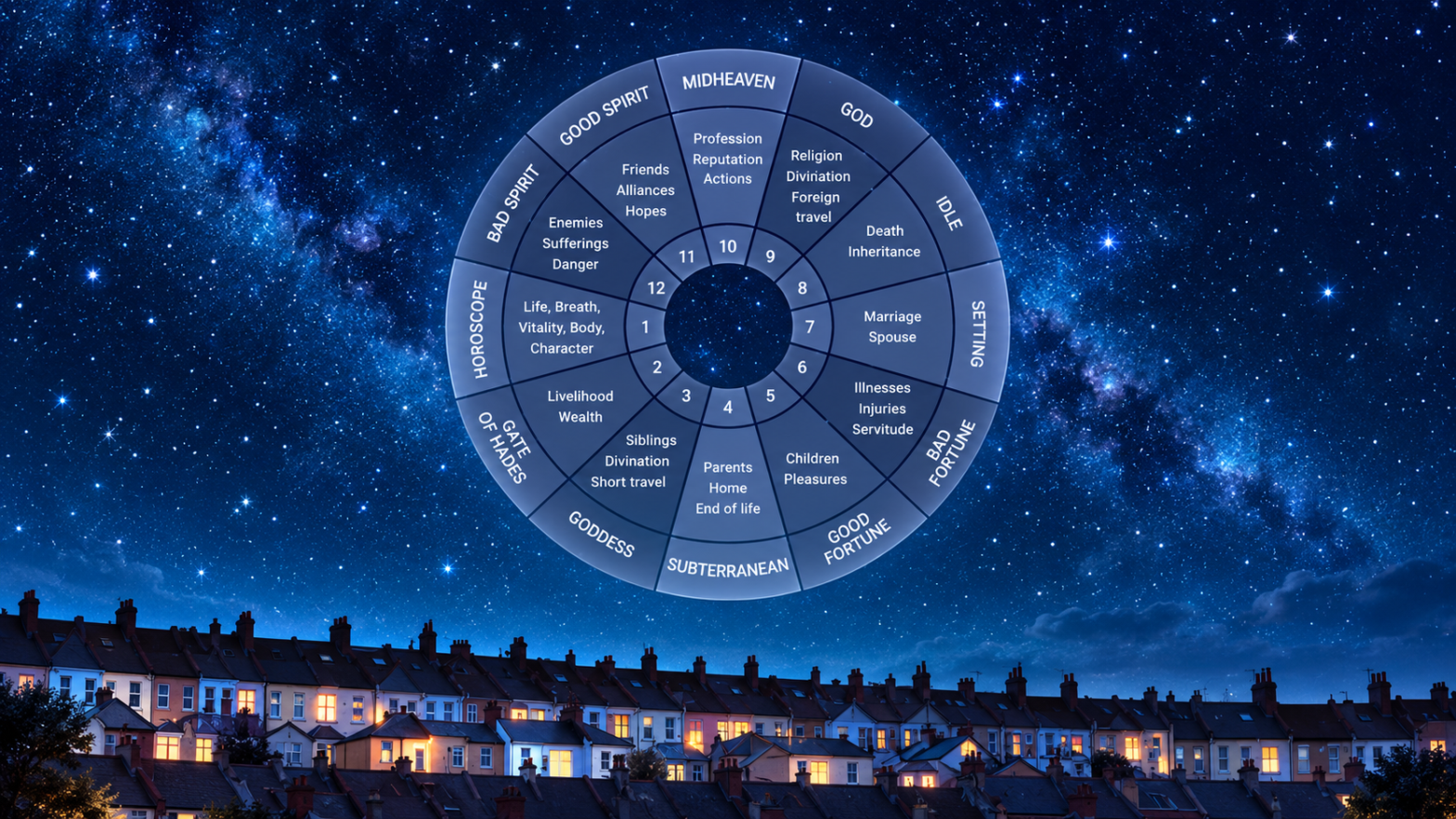
Welcome to Lesson 4 of the Satya Traditional Natal Astrology Course.
In the previous lesson, you learned that a planet shows what is acting and the sign shows how the planet acts. In this lesson, you will add another important layer: the whole sign houses.
The houses show where the planet acts and which areas of life it affects.
This lesson focuses on the whole sign house system. In this system, each zodiac sign becomes one complete house. You will learn how the twelve whole sign houses are classified, how favorable or unfavorable they are, and what topics each house signifies.
You will begin by learning how the houses are classified as angular, succedent, and cadent. You will then study which houses aspect the Ascendant and which houses are in aversion to it. These principles will help you understand why some houses are considered more favorable than others.
You will also learn the house favorability grading system used throughout this course. You will practice assigning a grade to a planet based on its whole sign house placement.
Next, you will study the planetary joys. Each of the seven traditional planets has one house where it rejoices.
You will then study the main topics of all twelve houses, from the first house of the body and self to the twelfth house of suffering, enemies, confinement, and hidden matters. You will also be introduced to derived houses, which allow you to find additional meanings by counting one house from another.
Finally, you will learn how to delineate a planet in a whole sign house by combining:
Planet + Sign + House
The planet tells you what is acting.
The sign tells you how it acts.
The house tells you where in life it acts.
You will apply this method to the example charts used throughout the course, including Charles Dickens, Petrarch, Nicolaus Copernicus, and Bal Gangadhar Tilak.
In the next lesson, you will study quadrant houses and learn how they add another layer of strength and emphasis to the chart.
Learning Outcomes
By the end of this lesson, you should be able to:
- classify each of the twelve whole sign houses as angular, succedent, or cadent
- identify the houses that aspect the Ascendant and the houses that are in aversion to it
- distinguish favorable houses from unfavorable houses
- assign the correct house favorability grade from A+ to D based on whole sign house placement
- identify the house of joy for each of the seven traditional planets
- list the main topics associated with each of the twelve houses
- use derived houses to identify selected secondary house meanings
- distinguish similar house topics, such as open enemies and secret enemies, or small and large animals
- combine the meanings of a planet, sign, and whole sign house to produce a basic natal delineation
- apply whole sign house favorability and house topics to the example charts used in the course
1. Favorability of the Houses
Traditional astrologers did not treat all twelve houses as equally favorable.
Some houses were considered strong and supportive. Others were considered weak, difficult, or harmful. One important reason is their relationship to the Ascendant.
Hephaistio gives a traditional ranking of the houses:
The following are the good places in which it is necessary for them [the planets] to be placed. First, the Horoskopos; second, the Midheaven; third, the Good Spirit; fourth, the Good Fortune; after these the Descendant; then the pivot under the earth; after all [of these], the ninth place, the so-called God. These are the good places. Evil are the second and third from the Horoskopos, and the eighth; the two remaining, which are the sixth and twelfth, are the worst.”
Hephaistio, Apotelesmatics
In this section, you will learn how house position helps us judge favorability. We will begin with one of the basic classifications: angular, succedent, and cadent houses.
1.1 Angular, Succedent, and Cadent Houses
The houses can be divided into three groups based on their position relative to the four angles of the horoscope.
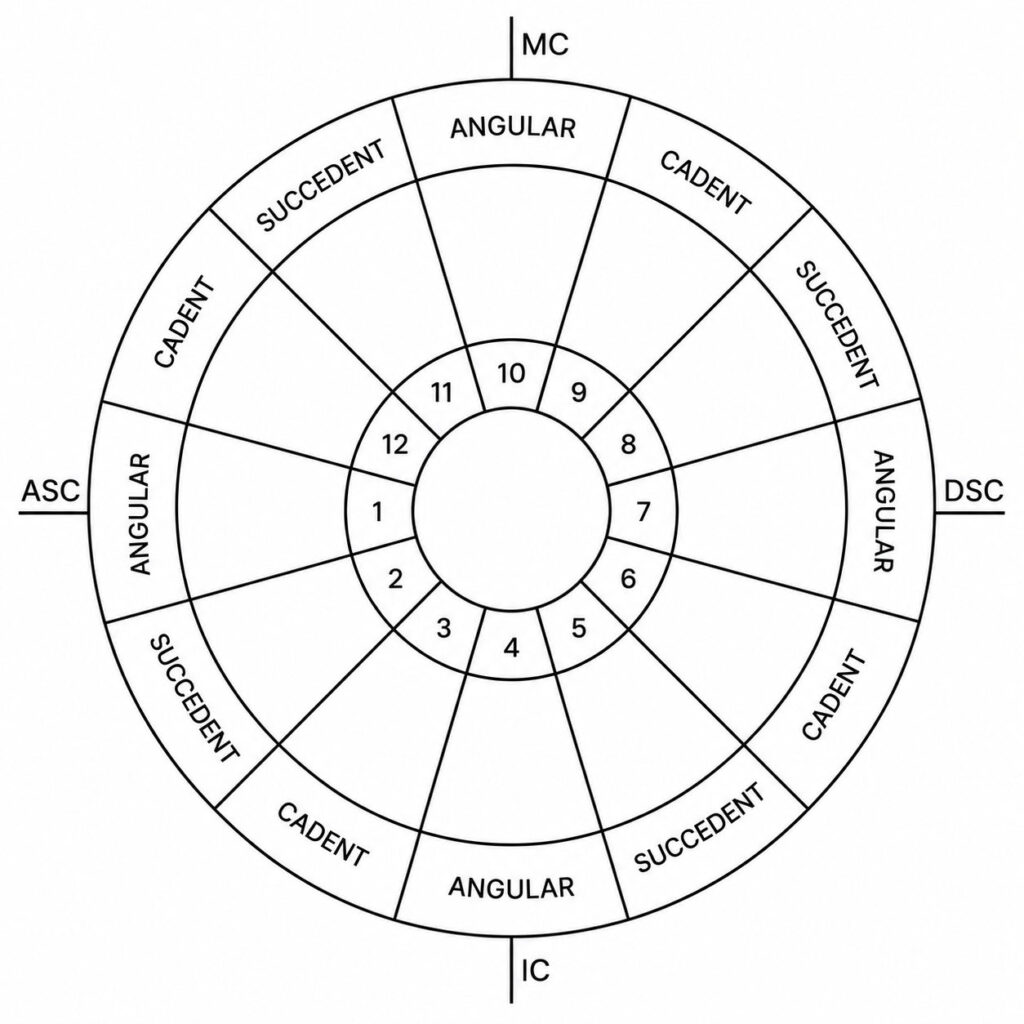
The four angles are:
- Ascendant (ASC)
- Midheaven (MC)
- Descendant (DSC)
- Imum Coeli (IC)
The Imum Coeli is the point opposite the Midheaven.
In this lesson, we are focusing on these classifications within the whole sign house system.
Angular Houses
The angular houses are:
- 1st house
- 4th house
- 7th house
- 10th house
These houses are aligned with the four main angles and represent areas of major importance in life.
Their main topics include:
- 1st house: self, body, life, and primary motivation
- 4th house: home, family, ancestry, and foundations
- 7th house: marriage, partnerships, and other people
- 10th house: career, reputation, rank, and public life
Planets in angular houses tend to be more prominent and active in the life of the native.
Demetra George gives a useful image for understanding their importance. If you place an upright human figure inside the wheel of houses, the head reaches the tenth house, the feet reach the fourth house, and the outstretched arms reach the first and seventh houses.
These four houses therefore describe central areas of human life: the self, the partner, public life, and private foundations.
Succedent Houses
The succedent houses follow the angular houses.
They are:
- 2nd house
- 5th house
- 8th house
- 11th house
These houses come into prominence after the angular houses by primary motion.
Succedent houses are generally less prominent than angular houses, but they are not all equal in favorability. As you will see in the next section, the fifth and eleventh houses are favorable, while the second and eighth houses are more difficult.
Cadent Houses
The cadent houses follow the succedent houses.
They are:
- 3rd house
- 6th house
- 9th house
- 12th house
The word cadent means that these houses have fallen away from the angles.
Cadent houses are generally weaker than angular and succedent houses. However, they are not all unfavorable.
The third and ninth houses are considered favorable because they aspect the Ascendant. The sixth and twelfth houses are considered especially difficult because they are both cadent and in aversion to the Ascendant.
The sixth house is associated with illness, injury, and servitude. The twelfth house is associated with enemies, suffering, confinement, and misfortune.
Key Idea
The three house groups describe different levels of prominence:
- Angular houses: strongest and most prominent
- Succedent houses: follow the angles and have moderate strength
- Cadent houses: fall away from the angles and are generally weaker
But angularity alone does not determine whether a house is favorable.
In the next section, you will learn how the house’s aspect to the Ascendant changes the judgment.
1.2 Houses in Aversion to the First House
In traditional astrology, the first house represents the native. Because of this, the relationship of the other houses to the first house is important when judging house favorability.
Traditional astrology uses five major aspects:
- Conjunction: 0°
- Sextile: 60°
- Square: 90°
- Trine: 120°
- Opposition: 180°
You will study aspects in detail in a later lesson. For now, you only need to understand how whole sign aspects work.
In whole sign astrology, aspects are formed between signs. Each sign contains 30 degrees.
For example, if Aries is the first house:
- Aries is conjunct Aries.
- Aries sextiles Gemini and Aquarius.
- Aries squares Cancer and Capricorn.
- Aries trines Leo and Sagittarius.
- Aries opposes Libra.
This means that the following houses aspect the first house:
- 3rd
- 4th
- 5th
- 7th
- 9th
- 10th
- 11th
These houses can be said to see the Ascendant. Because they are configured to the first house, they have a more direct relationship with the native.
What Is Aversion?
A house is in aversion to the first house when it does not form one of the five traditional aspects to the Ascendant sign.
Aversion means an inability to see. Traditional astrologers also described it as a kind of blindness or disconnection.
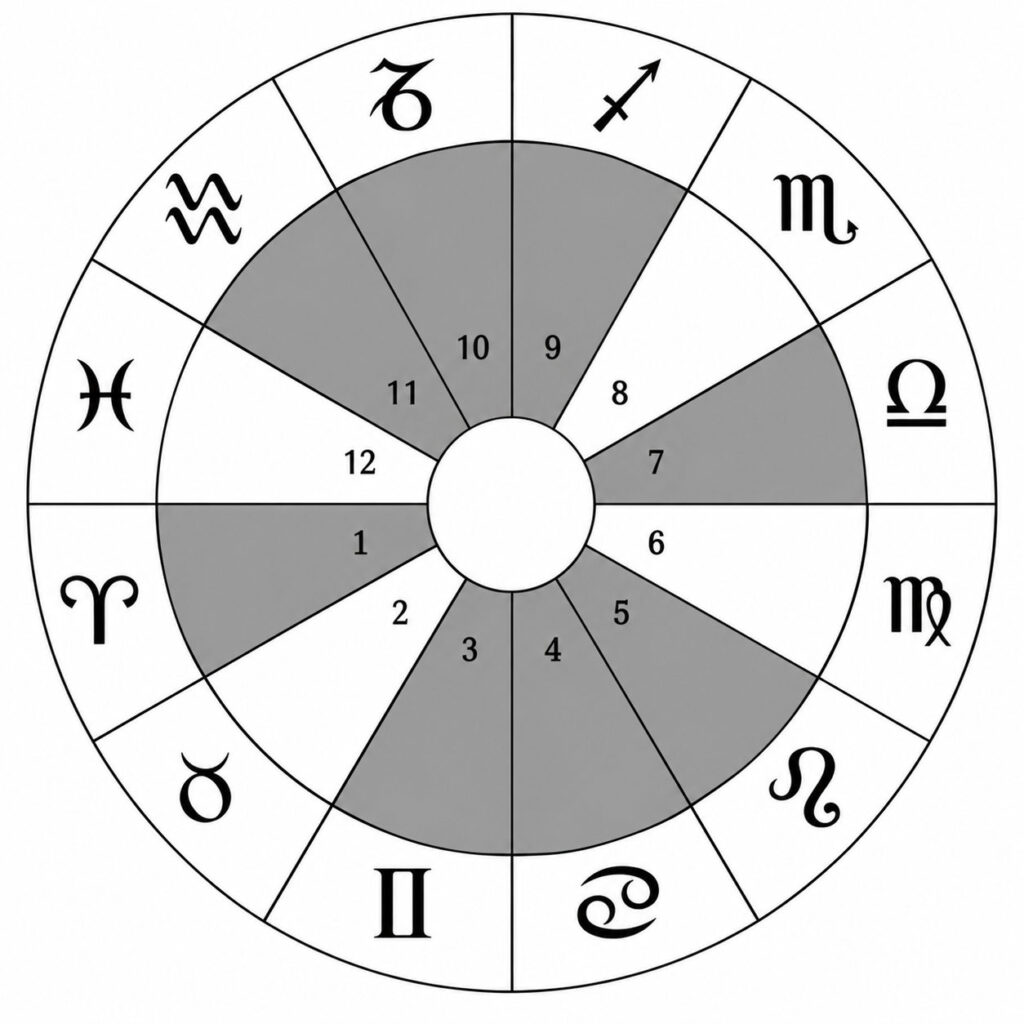
The houses in aversion to the first house are:
- 2nd house
- 6th house
- 8th house
- 12th house
These houses do not aspect the Ascendant.
They are therefore considered more difficult and are associated with topics that may be unfavorable to the native.
For example:
- 2nd house: loss of wealth or poverty
- 6th house: illness, injury, and servitude
- 8th house: death, fear, and anguish
- 12th house: enemies, suffering, and confinement
There is often a theme of isolation, fear, ignorance, pain, or loss in these houses.
The second house can be especially difficult when malefic planets in poor condition are placed there, since this can indicate poverty or loss of resources.
The astrologer and scholar James Holden referred to the second, sixth, eighth, and twelfth houses as the “Four Evil Houses.”
Key Idea
Houses that aspect the first house can see the native.
Houses in aversion cannot see the first house and are therefore more disconnected from the native.
Remember the four houses in aversion:
2nd, 6th, 8th, and 12th.
These four houses will become important when you judge whether a planet is placed in a favorable or unfavorable part of the chart.
1.3 Favorable and Unfavorable Houses
We can now combine two ideas you have already learned:
- whether a house is angular, succedent, or cadent
- whether a house aspects the Ascendant or is in aversion to it
Together, these help us judge which houses are favorable and which are unfavorable.
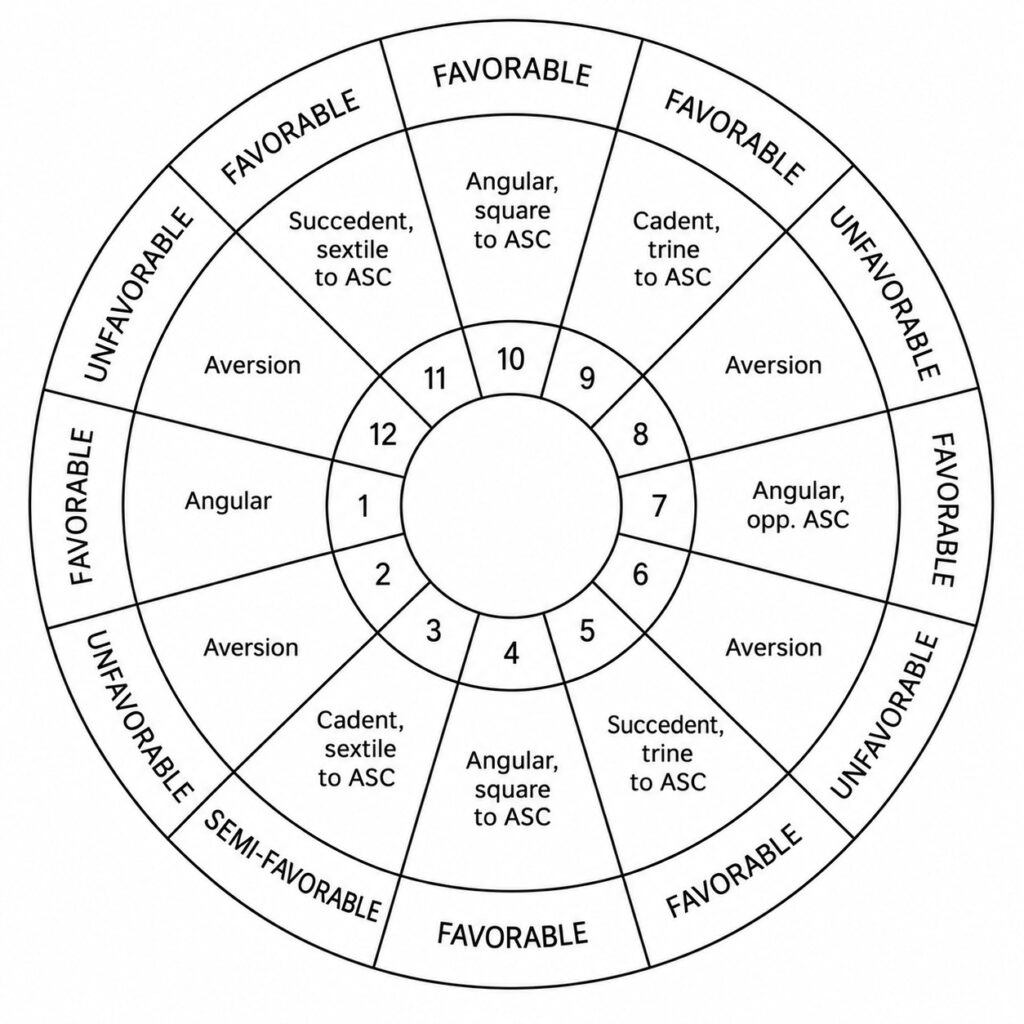
Favorable Houses
The angular houses are favorable because they are prominent and they aspect the Ascendant.
These are:
- 1st house
- 4th house
- 7th house
- 10th house
The succedent houses that aspect the Ascendant are also favorable:
- 5th house, the house of Good Fortune
- 11th house, the house of Good Spirit
The fifth house signifies children, pleasure, and creativity. The eleventh house signifies friends, alliances, hopes, and support.
The cadent houses that aspect the Ascendant are favorable as well:
- 3rd house, the house of the Goddess
- 9th house, the house of God
The third house signifies siblings, short journeys, learning, and communication. The ninth house signifies religion, higher learning, and foreign travel.
The third house is traditionally somewhat less favorable than the ninth, but both are able to see the Ascendant.
Unfavorable Houses
The succedent houses that are in aversion to the Ascendant are unfavorable:
- 2nd house, the Gate of Hades
- 8th house, the Idle Place
The second house signifies wealth and livelihood, but it can also show poverty or loss of resources. The eighth house signifies death, fear, inheritance, and other difficult topics.
The cadent houses in aversion to the Ascendant are the most difficult:
- 6th house, the house of Bad Fortune
- 12th house, the house of Bad Spirit
The sixth house signifies illness, injury, servitude, and labor. The twelfth house signifies enemies, suffering, confinement, and misfortune.
Key Idea
The favorable houses are:
1st, 3rd, 4th, 5th, 7th, 9th, 10th, and 11th
The unfavorable houses are:
2nd, 6th, 8th, and 12th
A house becomes more favorable when it has a stronger connection to the Ascendant.
A house becomes more difficult when it is in aversion to the Ascendant, especially when it is also cadent.
1.4 Grading Scheme
Throughout this course, you will use a grading system to judge different parts of a planet’s condition.
The basic scale has eight levels:
| Grade | Meaning |
| A+ | Excellent |
| A | Very good |
| B+ | Good, possibly mixed with some difficulty |
| B | Good, possibly mixed with some difficulty |
| C+ | Bad, possibly mixed with some good |
| C | Bad, possibly mixed with some good |
| D+ | Very poor, with only slight good |
| D | Worst |
Grades A+, A, B+, and B are favorable.
Grades C+, C, D+, and D are unfavorable.
You will use this same basic scale throughout the course when judging factors such as:
- house favorability
- sect
- essential dignity
- solar phase
- quadrant strength
The purpose of grading is to make your judgment more consistent. Instead of simply saying that a placement is “good” or “bad,” you can describe its relative strength more precisely.
In some later sections, additional levels may be added when more detail is needed.
1.5 Grading House Favorability
You can now assign a favorability grade to a planet based on its whole sign house placement.
| Whole Sign House | Grade |
| 1st | A+ |
| 10th | A+ |
| 11th | A |
| 5th | A |
| 7th | B+ |
| 4th | B+ |
| 9th | B |
| 3rd | B |
| 2nd | C+ |
| 8th | C |
| 6th | D+ |
| 12th | D |
The first and tenth houses receive the highest grade because they are the most prominent angular houses.
The fifth and eleventh houses are also strongly favorable. They aspect the Ascendant and are traditionally known as Good Fortune and Good Spirit.
The seventh and fourth houses are favorable angular houses.
The third and ninth houses are cadent, but they still aspect the Ascendant. For this reason, they receive favorable grades.
The second, eighth, sixth, and twelfth houses are in aversion to the Ascendant and receive unfavorable grades. The sixth and twelfth houses receive the lowest grades.
Example 1: Charles Dickens
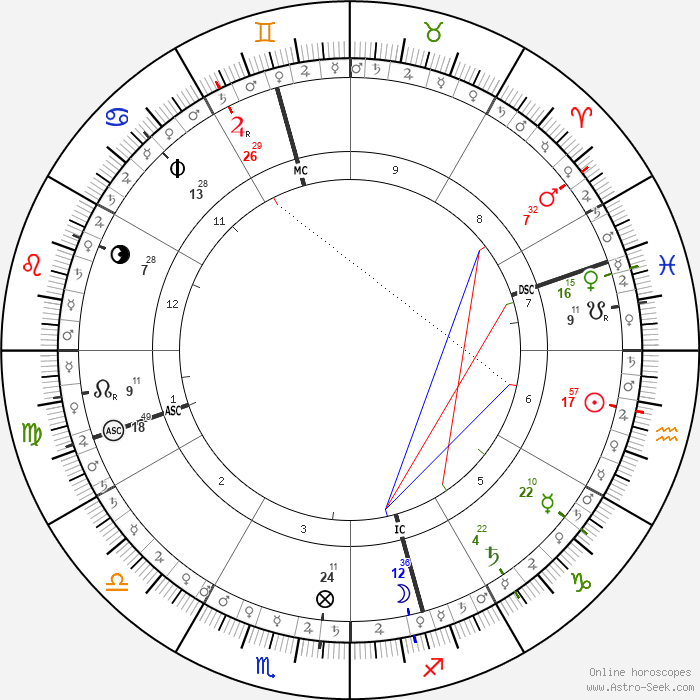
In Charles Dickens’ chart, the house favorability grades are:
- Jupiter: A+
- Saturn: A
- Mercury: A
- Moon: B+
- Venus: B+
- Mars: C
- Sun: D+
Jupiter is in the tenth house and receives an A+, making it the best-placed planet by house favorability.
Saturn and Mercury are in the fifth house and receive an A.
The Moon and Venus are also favorably placed in the fourth and seventh houses.
Mars is in the unfavorable eighth house and receives a C. The Sun is in the sixth house and receives a D+.
Example 2: Petrarch
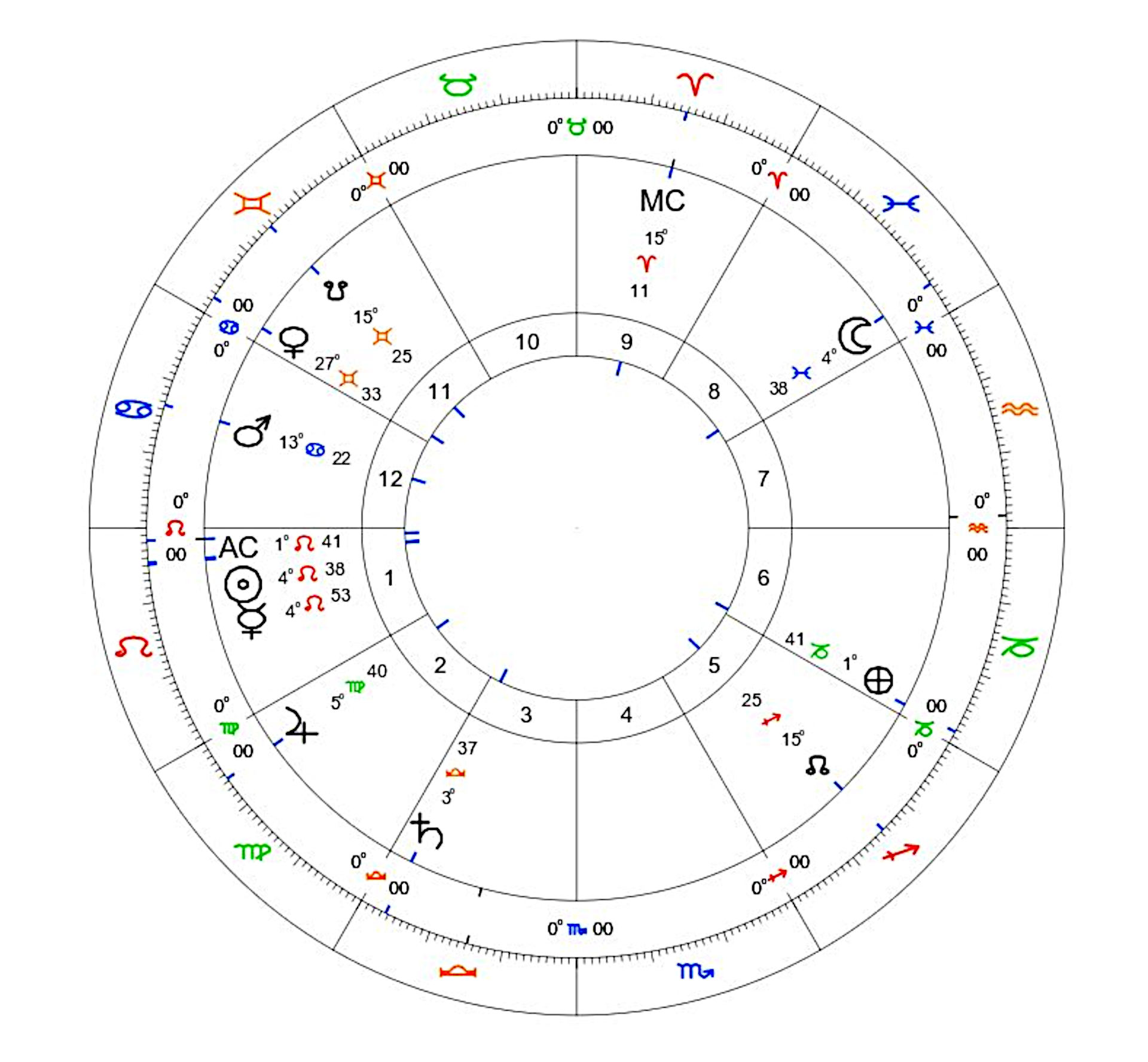
In Petrarch’s chart, the house favorability grades are:
- Sun: A+
- Mercury: A+
- Venus: A
- Saturn: B
- Jupiter: C+
- Moon: C
- Mars: D
The Sun and Mercury are in the first house and receive the highest grade, A+.
Venus is in the favorable eleventh house and receives an A. Saturn is in the third house and receives a B.
Jupiter is in the unfavorable second house and receives a C+. The Moon is in the eighth house and receives a C.
Mars is in the twelfth house and receives a D, the lowest house favorability grade.
Important Note
House favorability is only one part of judging a planet.
A planet’s overall condition also depends on:
- whether it is benefic or malefic
- sect
- essential dignity
- solar phase
- aspects
- other conditions you will study later
A favorable house can strengthen a planet’s ability to act, while an unfavorable house can make its topics more difficult. But the final judgment must consider the planet as a whole.
Key Idea
To grade house favorability, first identify the planet’s whole sign house.
Then assign the corresponding grade.
This gives you one clear measure of how favorable or unfavorable the planet’s location is in the birth chart.
2. Planetary Joys by House
Each of the seven traditional planets has one house where it rejoices.
Al-Qabisi explains:
“And each one of the planets has a certain power… in one of these houses, which is said to be a ‘joy.’ Because Mercury rejoices in the Ascendant, and the Moon in the third, also Venus in the fifth and Mars in the sixth, the Sun in the ninth and Jupiter in the eleventh, but Saturn in the twelfth.”
Al-Qabisi, Introduction to the Science of Astrology, trans. Benjamin Dykes
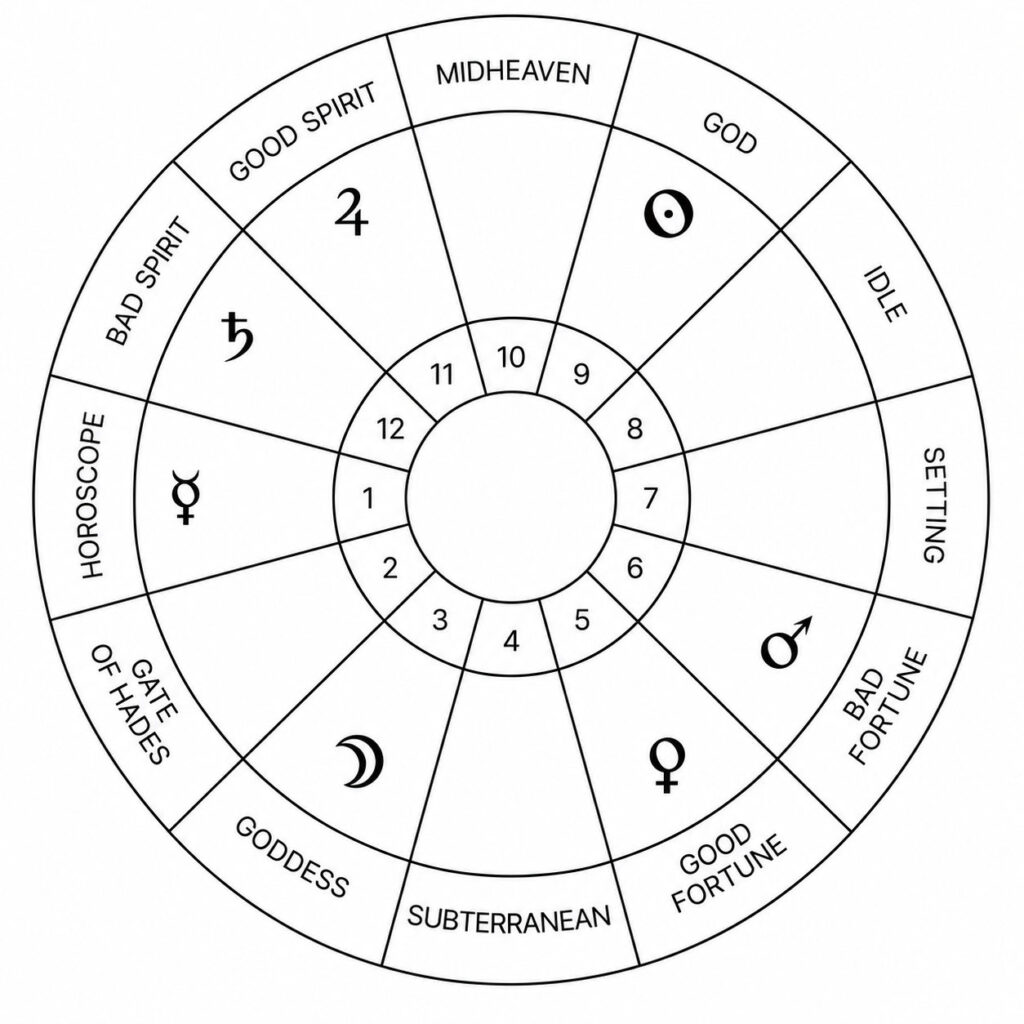
The planetary joys are:
| Planet | House of Joy |
| Mercury | 1st |
| Moon | 3rd |
| Venus | 5th |
| Mars | 6th |
| Sun | 9th |
| Jupiter | 11th |
| Saturn | 12th |
Joys and Sect
The planetary joys also follow the division between the diurnal and nocturnal sects.
The diurnal planets rejoice in houses above the horizon:
- Sun: 9th house
- Jupiter: 11th house
- Saturn: 12th house
The nocturnal planets rejoice in houses below the horizon:
- Moon: 3rd house
- Venus: 5th house
- Mars: 6th house
Mercury is different. Mercury has its joy in the 1st house.
Benefics and Malefics in Their Joys
Notice an important pattern.
The benefics rejoice in favorable houses:
- Venus rejoices in the 5th house, the house of Good Fortune.
- Jupiter rejoices in the 11th house, the house of Good Spirit.
The malefics rejoice in unfavorable houses:
- Mars rejoices in the 6th house, the house of Bad Fortune.
- Saturn rejoices in the 12th house, the house of Bad Spirit.
This shows that a house of joy is not the same as a favorable house. A planet may rejoice in a house even when the house itself signifies difficult topics.
Examples from the Course Charts
You can already see the planetary joys in the example charts.
- Mercury in Petrarch’s chart is in the 1st house, Mercury’s house of joy.
- Mars in Copernicus’ chart is in the 6th house, Mars’ house of joy.
As you continue through the course, the planetary joys will give you another factor to consider when judging a planet’s condition.
Key Idea
Each traditional planet has one house where it rejoices.
Remember the pattern:
- Mercury: 1st
- Moon: 3rd
- Venus: 5th
- Mars: 6th
- Sun: 9th
- Jupiter: 11th
- Saturn: 12th
The joys add another layer to house interpretation and planetary condition.
3 House Topics
First House: Ascendant
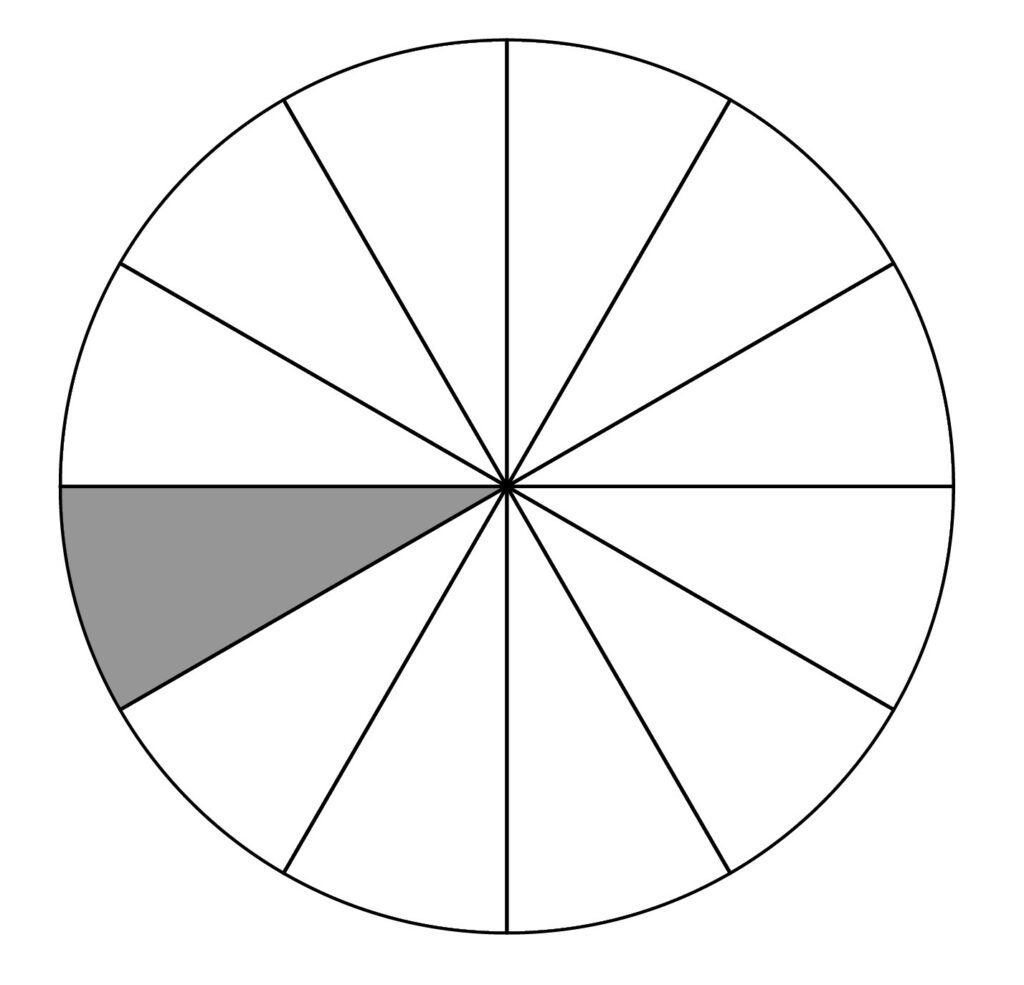
The first house is also called the Ascendant or Horoskopos.
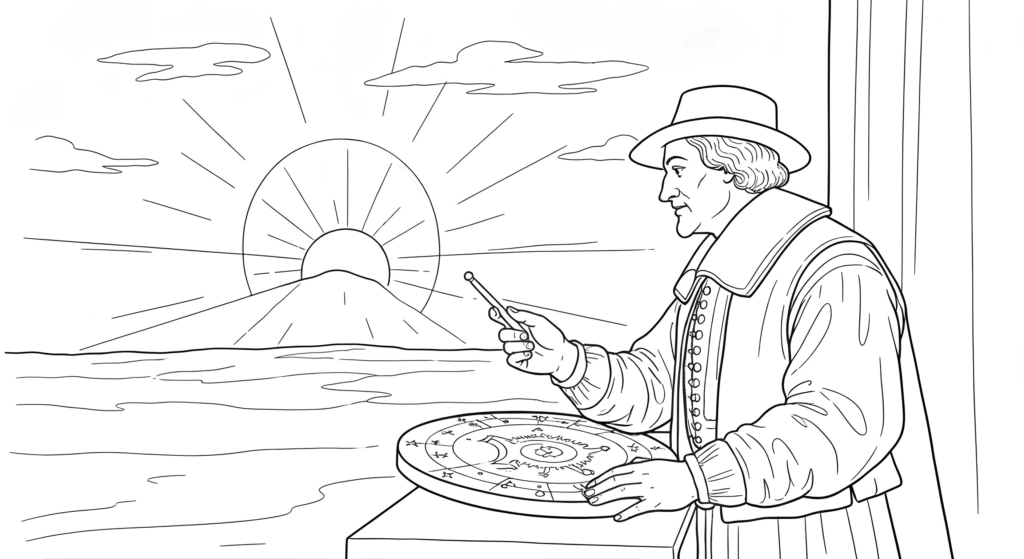
Traditional authors connect the first house with life, the body, character, beginnings, and the native’s overall direction.
Paulus of Alexandria describes the first house as the:
“Giver of life and breath, helm, time of youth, joy of Mercury.”
Abu Ma’shar connects it with:
“The body and life of the native and all their undertakings, conditions of every commencement and motion.”
Al-Biruni includes:
“Soul, life, length of life, education, native land.”
These traditional descriptions show that the first house is closely connected with the native as a whole.
Main Topics of the First House
The first house signifies:
- primary motivation
- life and vitality
- the body
- physical appearance
- physical constitution
- temperament
- character
The sign on the first house and the ruler of that sign are especially important for understanding the native’s basic motivation and way of approaching life.
The first house, planets placed there, and the ruler of the first house are also used when judging physical appearance and temperament.
Planets in the First House
The first house is angular, so planets placed here are prominent.
Their qualities are often easy to notice in the person.
For example:
- Moon in the first house: feelings and emotional responses may be clearly visible.
- Mercury in the first house: speech, curiosity, learning, or communication may become a strong part of the person’s identity.
A planet in the first house often becomes closely connected with how the native presents themselves and how others experience them.
Derived House Meanings
The first house can also signify additional topics when counted from other houses.
It may represent:
- father’s reputation: tenth from the fourth house
- employee termination or resignation: eighth from the sixth house
- maternal grandfather: fourth from the tenth house
- paternal grandmother: tenth from the fourth house
You will use derived houses throughout this section to find additional meanings beyond the basic topics of each house.
Key Idea
The first house represents the native themselves.
When judging it, pay attention to:
- the sign of the first house
- the ruler of that sign
- planets placed in the first house
Together, these help describe the native’s body, temperament, character, and primary motivation.
Second House: Gate of Hades
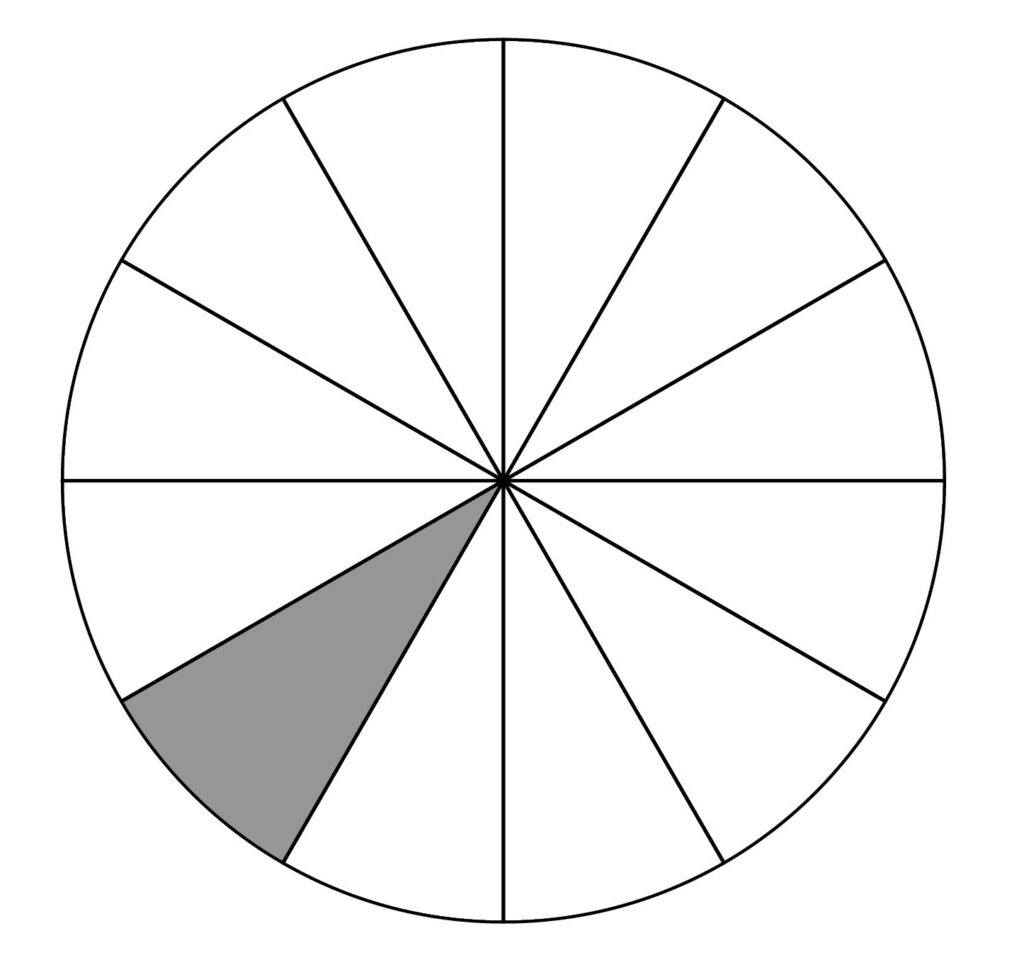
The second house is traditionally called the Gate of Hades.
It is mainly connected with livelihood, money, possessions, and the resources needed to support life.
Paulus of Alexandria links the second house with:
“Livelihood, Gate of Hades, giver of good expectations.”
Abu Ma’shar connects it with:
“Possession, dealings, wealth, gathering and storing wealth, means and conditions of livelihood, receiving and giving.”
Al-Biruni includes livelihood, household needs, assistants, and the profession of children.
These descriptions show that the second house is concerned with what the native owns, earns, receives, and uses for support.

Main Topics of the Second House
The second house signifies:
- moveable wealth
- money
- possessions
- livelihood
- income and resources
- assistants
- advisors
The second house shows the resources available to the native and how livelihood is maintained.
Favorability of the Second House
The second house does not aspect the first house. It is therefore in aversion to the Ascendant and is considered unfavorable.
This does not mean that the second house always produces poverty.
A benefic planet in the second house may support the acquisition or preservation of wealth.
A malefic planet in poor condition may indicate:
- financial loss
- heavy expenditures
- difficulty earning
- poverty or lack of resources
The condition of the planet must always be considered before making a final judgment.
Derived House Meanings
The second house also has additional meanings when counted from other houses.
It may represent:
- death of the marriage partner: eighth from the seventh house
- partner’s investments or debts: eighth from the seventh house
- profession of children: tenth from the fifth house
These derived meanings show how one house can describe topics connected with another person in the native’s life.
Key Idea
The second house is the house of money, possessions, and livelihood.
When judging it, consider:
- planets placed in the second house
- the condition of those planets
- whether benefics or malefics are present
- the ruler of the second house
These factors help you judge the native’s resources and financial circumstances.
Third House: Goddess
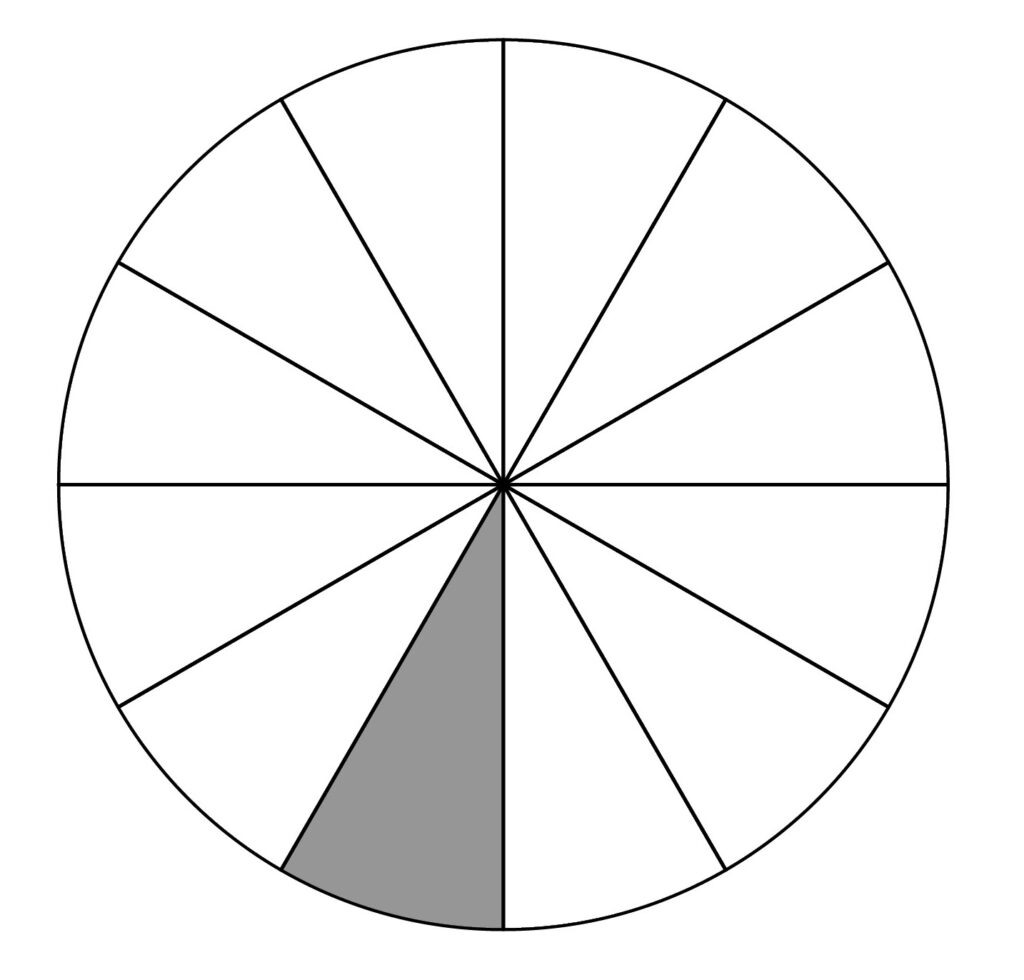
The third house is traditionally called the Goddess.
It is mainly connected with siblings, relatives, early learning, communication, short journeys, and divination. The Moon has her joy in this house.
Paulus of Alexandria connects the third house with:
“Brothers, Goddess, house and joy of the Moon, patronage, living abroad.”
Abu Ma’shar links it with brothers, sisters, relatives, books, rumors, messengers, travelers, religion, and dreams.
Al-Biruni includes brothers, sisters, relations, law, friends, migration, short journeys, intelligence, and knowledge.
These descriptions show that the third house is strongly connected with close relations, learning, movement, and the exchange of information.

Main Topics of the Third House
The third house signifies:
- siblings
- relatives
- friends
- neighbors and neighborhood
- primary education and early learning
- short-distance travel
- local transportation
- writing and communication
- publishing
- publicity
- press and media
- dreams
- divination
Favorability of the Third House
The third house is cadent, so it is weaker than an angular or succedent house.
However, it aspects the Ascendant by sextile. For this reason, it is considered a favorable house in this course.
The third house is also the joy of the Moon, which reinforces its connection with movement, messages, changing circumstances, and the immediate environment.
Planets in the Third House
Planets placed in the third house can describe siblings and other third-house topics.
For example:
- Mars in the third house may indicate a brother.
- Venus in the third house may indicate a sister.
In Petrarch’s chart, Saturn is in the third house. In his life, Saturn can signify his brother Gherardo, who became a monk.
This shows how a planet can describe not only the native, but also another person connected with the house.
Key Idea
The third house is the house of siblings, learning, communication, short journeys, and divination.
When judging it, consider:
- planets placed in the third house
- the ruler of the third house
- the condition of those planets
- how the planet’s nature connects with third-house topics
This helps you judge how the native experiences siblings, learning, communication, and the immediate environment.
Fourth House: Subterranean Place
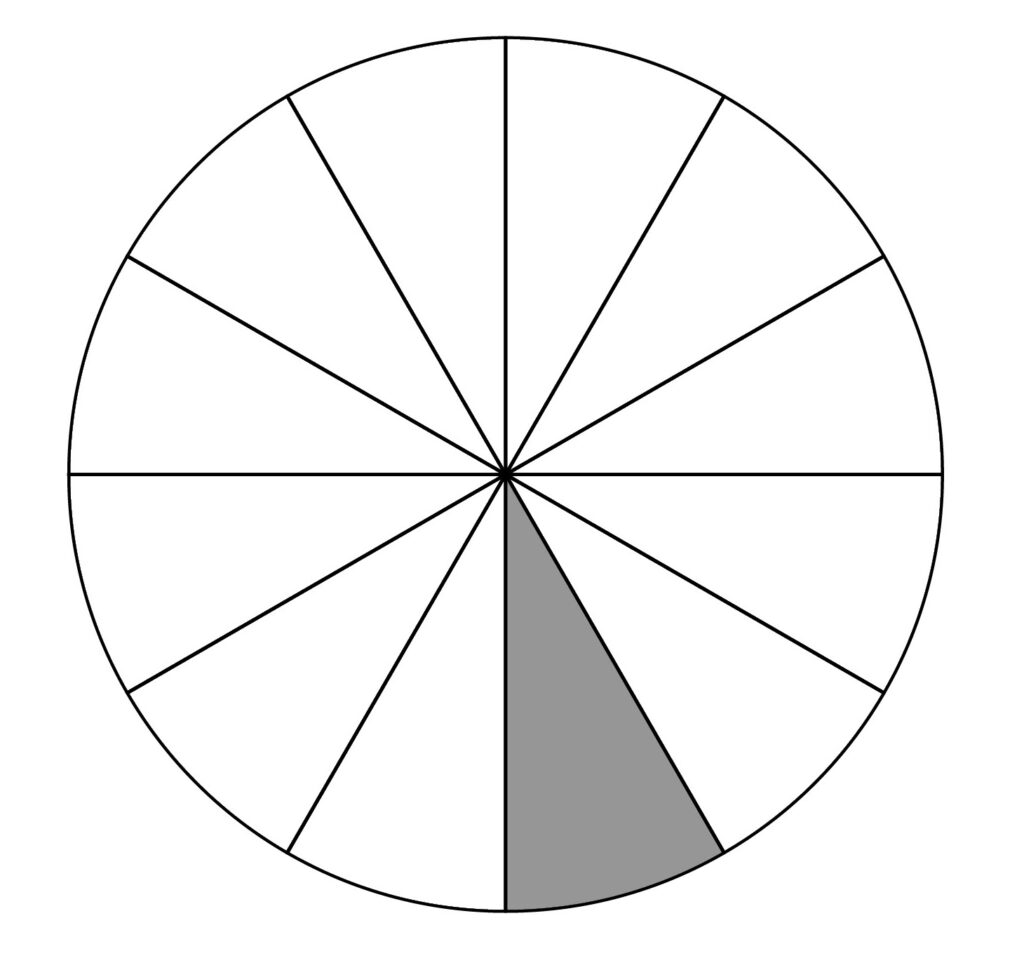
The fourth house is traditionally called the Subterranean Place.
It is mainly connected with the father, family, ancestry, home, land, property, and the foundations of life. It also signifies endings, burial, and things hidden beneath the earth.
Paulus of Alexandria connects the fourth house with:
“Time of old age, end of life, wrapping of corpse, matters after death, lands, foundations, parents, father, acquiring ships, house, dwelling place, household goods, close associations with others.”
Abu Ma’shar links it with the father, roots, race, land, buildings, hidden things, treasures, death, and burial.
Al-Biruni includes parents, grandparents, descendants, real estate, fields, houses, water supply, genealogy, and matters that follow death.
These descriptions show that the fourth house is strongly connected with origins, family foundations, property, ancestry, and the end of life.

Main Topics of the Fourth House
The fourth house signifies:
- father
- grandfather
- home and family
- ancestry and genealogy
- legacy, origins, and roots
- homeland
- land and real estate
- property and buildings
- foundations
- immovable wealth and possessions
- old or buried things
- relics and artifacts
- hidden treasures
- mining
- the end of a matter
- the end of life
- burial and the grave
Favorability of the Fourth House
The fourth house is angular and aspects the Ascendant.
For this reason, it is considered a favorable and prominent house.
Because it is angular, planets placed here can become important in the native’s life, especially in matters connected with family, home, property, ancestry, and the foundations of life.
Planets in the Fourth House
Planets in the fourth house can describe people, activities, and events connected with fourth-house topics.
For example:
- Mercury in the fourth house can indicate someone involved with records, family history, archives, or genealogy.
A planet in this house may also describe the condition of the father, the home, family property, or the native’s connection with their ancestry and homeland.
Key Idea
The fourth house is the house of family, roots, property, ancestry, and endings.
When judging it, consider:
- planets placed in the fourth house
- the ruler of the fourth house
- the condition of those planets
- how the planet’s nature connects with family, land, ancestry, and endings
This helps you judge the native’s private foundations and the matters that support or conclude the life.
Fifth House: Good Fortune
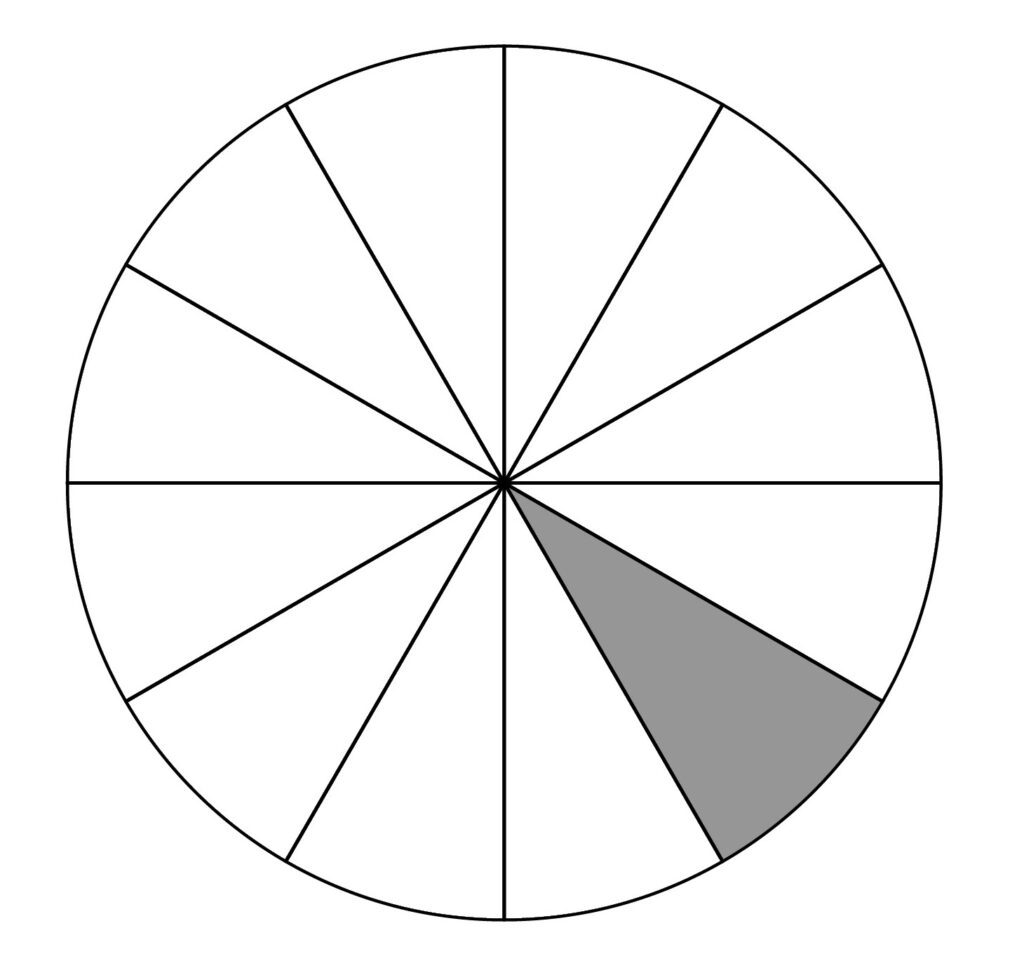
The fifth house is traditionally called Good Fortune.
It is mainly connected with children, creativity, pleasure, romance, recreation, gifts, and enjoyment. Venus has her joy in this house.
Paulus of Alexandria connects the fifth house with:
“Good Fortune, house of Venus, children, benefics rejoice and give good childbirth, malefics become destroyers of children.”
Abu Ma’shar links it with children, gifts, hope, friendship, messengers, and the revenues of landed estates.
Al-Biruni includes children, friends, clothes, pleasure, joy, property, and what is said about the native after death.
These descriptions show that the fifth house is strongly connected with enjoyment, children, creativity, and favorable outcomes.

Main Topics of the Fifth House
The fifth house signifies:
- children
- creativity
- romance
- recreation
- entertainment
- pleasure
- diplomats
- ambassadors
- representatives
- emissaries
- elections and voting
- journeys lasting about two to five days
Favorability of the Fifth House
The fifth house is succedent and aspects the Ascendant by trine.
For this reason, it is considered a favorable house.
It is also the house of Good Fortune and the joy of Venus, which strengthens its connection with pleasure, enjoyment, children, and favorable experiences.
Planets in the Fifth House
Planets placed in the fifth house can describe children and the native’s experience of fifth-house topics.
For example:
- Saturn in the fifth house may indicate difficulty, delay, or added responsibility connected with children.
A benefic planet in the fifth house may support pleasure, creativity, or children, while a malefic may bring more difficulty. The planet’s overall condition must still be considered.
Derived House Meanings
The fifth house also has important derived meanings.
It may represent:
- death or resignation of a king or ruler: eighth from the tenth house
- death of the mother: eighth from the tenth house
- money from houses or land: second from the fourth house
- family or father’s money: second from the fourth house
- inheritance from the father’s estate: second from the fourth house
- what is said after one’s death: second from the fourth house
These meanings show how the fifth house can describe topics connected with both the fourth and tenth houses.
Key Idea
The fifth house is the house of children, creativity, pleasure, and Good Fortune.
When judging it, consider:
- planets placed in the fifth house
- the ruler of the fifth house
- the condition of those planets
- how the planet’s nature connects with children, creativity, pleasure, and enjoyment
This helps you judge how fifth-house topics may develop in the native’s life.
Sixth House: Bad Fortune
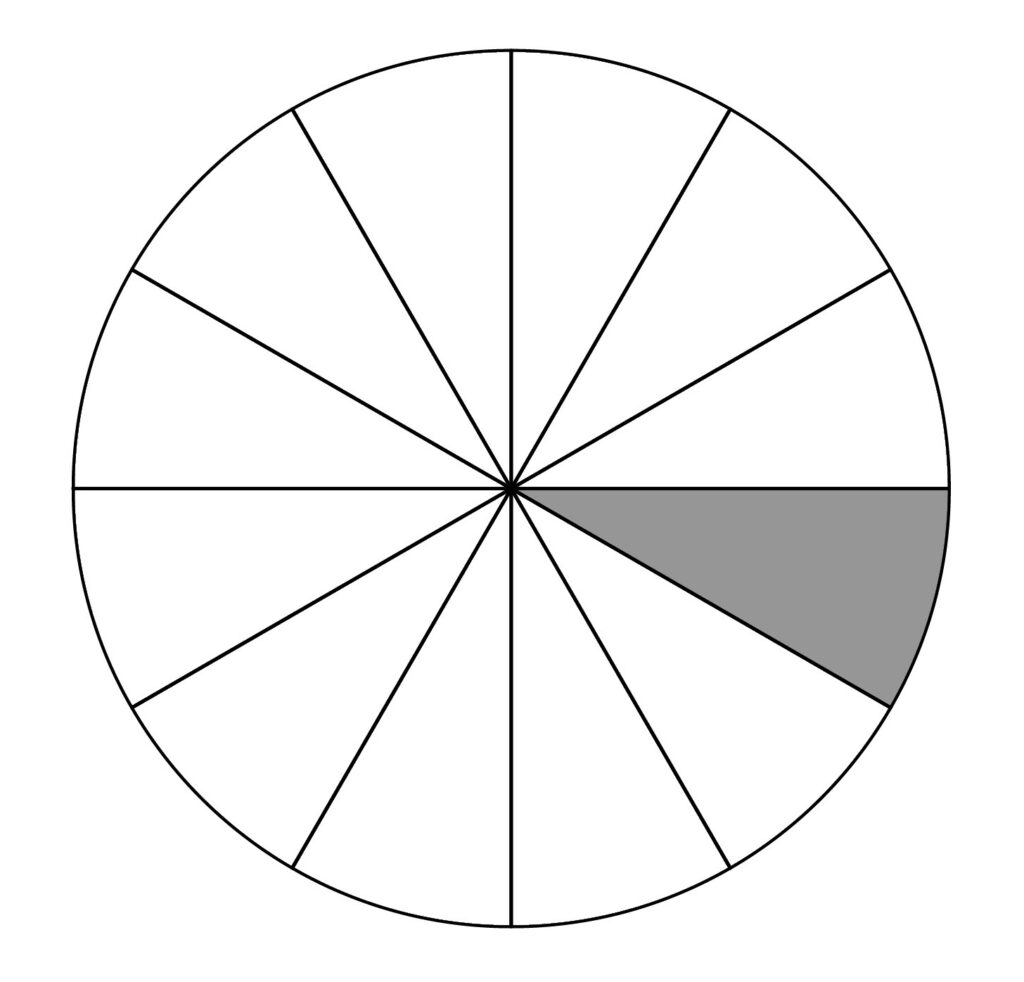
The sixth house is traditionally called Bad Fortune.
It is mainly connected with illness, injury, labor, servants, employees, and small animals. Mars has his joy in this house.
Paulus of Alexandria connects the sixth house with:
“Bad fortune, punishment, evil, cadent, house of Mars, injuries, female slaves, cattle, enmities arising from women, conspiracies, insurrections.”
Abu Ma’shar links it with illness, chronic illness, slaves, injustice, and difficult conditions.
Al-Biruni includes sickness, bodily defects, overwork, accidents, loss of property, and diseases of the internal organs.
These descriptions show that the sixth house is strongly connected with physical difficulty, labor, service, and burdens.

Main Topics of the Sixth House
The sixth house signifies:
- illness and disease
- accidents and injury
- slaves and servants
- jobs
- employees and coworkers
- labor and the labor class
- labor issues
- pets
- livestock
- domesticated animals
Favorability of the Sixth House
The sixth house is cadent and does not aspect the Ascendant.
For this reason, it is considered an unfavorable house.
It is also the house of Bad Fortune, which reinforces its connection with illness, injury, hardship, and servitude.
Mars rejoices in the sixth house. This does not make the house favorable. Instead, it shows that Mars is naturally suited to some of the difficult topics of the sixth house, such as injury, conflict, hard labor, and physical strain.
Planets in the Sixth House
Planets placed in the sixth house can describe illness, work, employees, or other sixth-house topics.
For example:
- Saturn in the sixth house may indicate chronic illness, long-term difficulty, or burdens connected with work.
The planet’s nature and condition will show how strongly these topics are expressed.
Derived House Meanings
The sixth house also has important derived meanings.
It may represent:
- father’s siblings: third from the fourth house
- children’s assets: second from the fifth house
- death of a friend: eighth from the eleventh house
This means that a planet in the sixth house can sometimes describe an uncle or aunt, because the sixth is the third house from the fourth house of the father.
Key Idea
The sixth house is the house of illness, injury, labor, service, and small animals.
When judging it, consider:
- planets placed in the sixth house
- the ruler of the sixth house
- the condition of those planets
- how the planet’s nature connects with illness, work, and service
This helps you judge how sixth-house difficulties may appear in the native’s life.
Seventh House: Setting
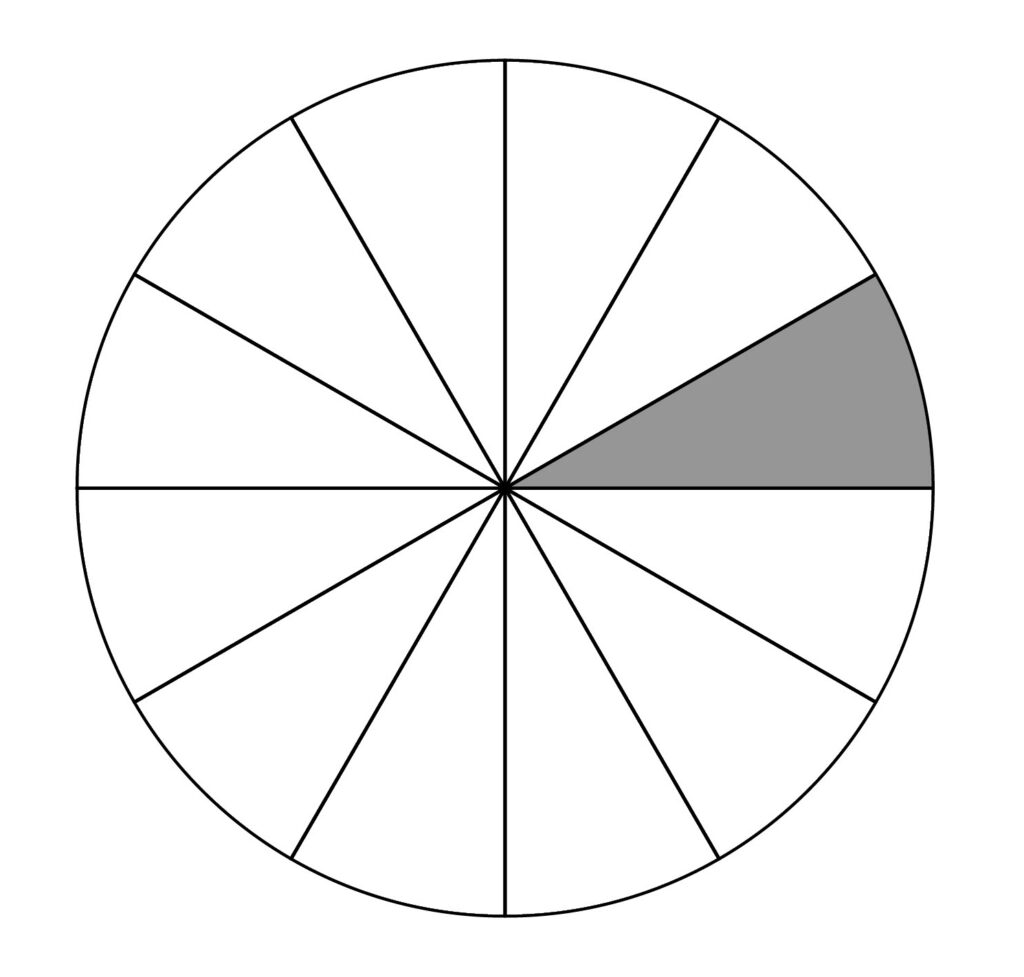
The seventh house is traditionally called the Setting Place because it is the western part of the chart where the Sun sets.
It is mainly connected with marriage, partners, open enemies, legal disputes, and the later part of life.
Paulus of Alexandria connects the seventh house with:
“Marriage arrangements, extended residences abroad, maker of death, the anti-Ascendant, the Setting sign, period of old age.”
Abu Ma’shar links it with women, marriage, controversies, opposition, journeys, and destruction.
Al-Biruni includes women, marriage, partnerships, losses, disputes, and lawsuits.
These descriptions show that the seventh house is strongly connected with close one-to-one relationships, opposition, and conflict with others.

Main Topics of the Seventh House
The seventh house signifies:
- marriage
- marriage partner
- partnerships
- business partnerships
- open enemies
- legal matters
- legal conflicts
- legal disputes
- lawsuits and litigation
- conditions of death
- old age
Favorability of the Seventh House
The seventh house is angular and directly opposes the Ascendant.
For this reason, it is considered a favorable and prominent house.
Because it is angular, planets placed here can become very important in the native’s life, especially in matters connected with marriage, partnerships, opponents, and legal disputes.
Planets in the Seventh House
Planets placed in the seventh house can describe the marriage partner, business partners, open enemies, or the nature of important one-to-one relationships.
For example:
- a benefic planet may support cooperation or partnership
- a malefic planet may bring conflict, delay, separation, or difficult opponents
The planet’s nature and condition must always be considered before making a final judgment.
Key Idea
The seventh house is the house of marriage, partnerships, open enemies, and legal conflict.
When judging it, consider:
- planets placed in the seventh house
- the ruler of the seventh house
- the condition of those planets
- how the planet’s nature connects with partnership, conflict, and opposition
This helps you judge how important one-to-one relationships and open conflicts may develop in the native’s life.
Eighth House: Idle or Inactive Place
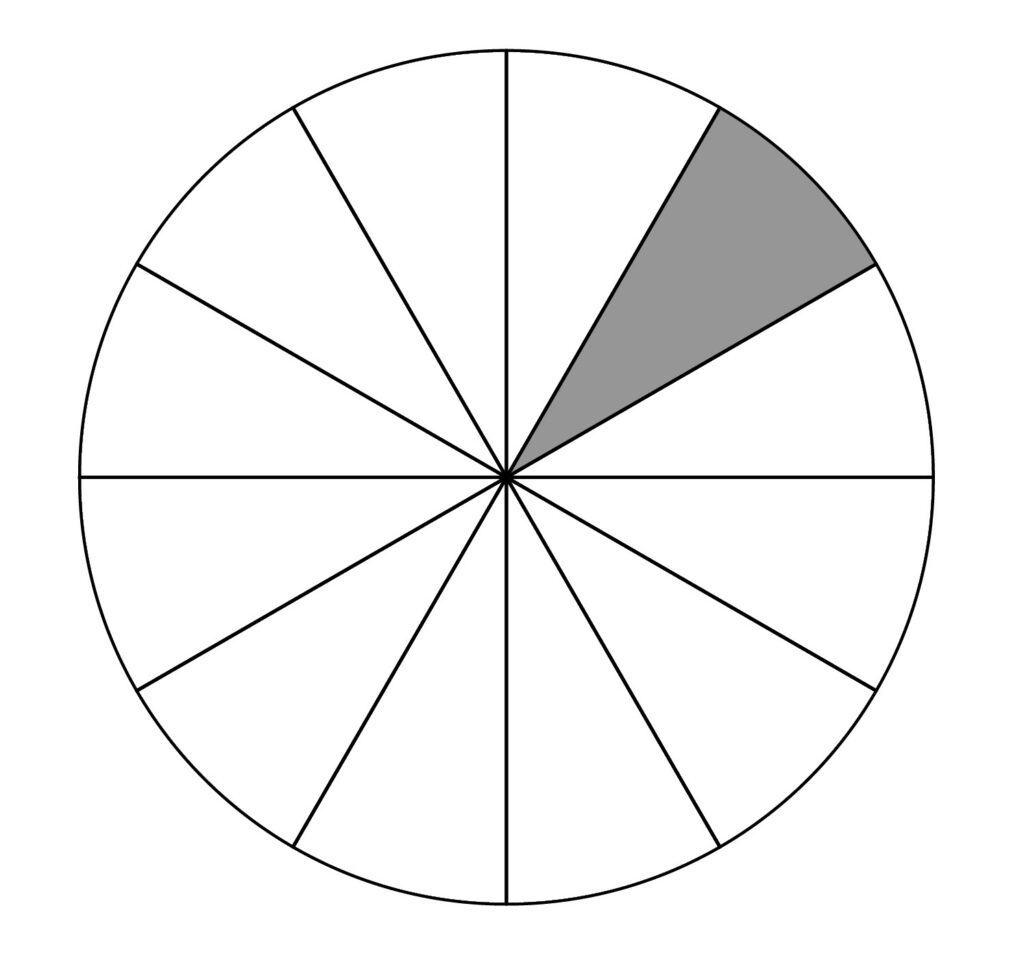
The eighth house is traditionally called the Idle or Inactive Place.
It is mainly connected with death, inheritance, debt, fear, and the resources of the spouse or partner.
Paulus of Alexandria connects the eighth house with:
“Idle place, averted and disconnected from the Ascendant, succedent of the Descendant, signifies death; unfortunate, but benefics give inheritances, profits from deaths.”
Abu Ma’shar links it with death, killing, inheritances, poisons, fear, loss, and mental disturbance.
Al-Biruni includes death and its causes, inheritance, the spouse’s property, expenditure, poverty, and extreme financial difficulty.
These descriptions show that the eighth house is strongly connected with death, loss, fear, inheritance, and financial obligations.

Main Topics of the Eighth House
The eighth house signifies:
- death
- inheritance
- pensions
- wills
- legacies
- trusts
- goods of the deceased
- debt
- taxes
- bankruptcy
- banking
- investments
- stocks and the stock market
- trade and traded goods
- fear
- anxiety
- anguish of the mind
Favorability of the Eighth House
The eighth house does not aspect the Ascendant.
For this reason, it is in aversion to the first house and is considered unfavorable.
Traditional authors connect this house with death, fear, loss, and mental anguish. However, benefic planets placed here can sometimes bring benefits through eighth-house topics such as inheritance or the resources of others.
The planet’s nature and condition must always be considered before making a final judgment.
Derived House Meanings
The eighth house is the second house from the seventh house.
For this reason, it can signify:
- spouse’s moveable wealth
- assets of open enemies
- dowry or wealth received through marriage
This is a useful example of how derived houses expand the meaning of a house.
Key Idea
The eighth house is the house of death, inheritance, debt, fear, and the resources of others.
When judging it, consider:
- planets placed in the eighth house
- the ruler of the eighth house
- the condition of those planets
- how the planet’s nature connects with loss, inheritance, debt, and fear
This helps you judge how eighth-house topics may appear in the native’s life.
Ninth House: God
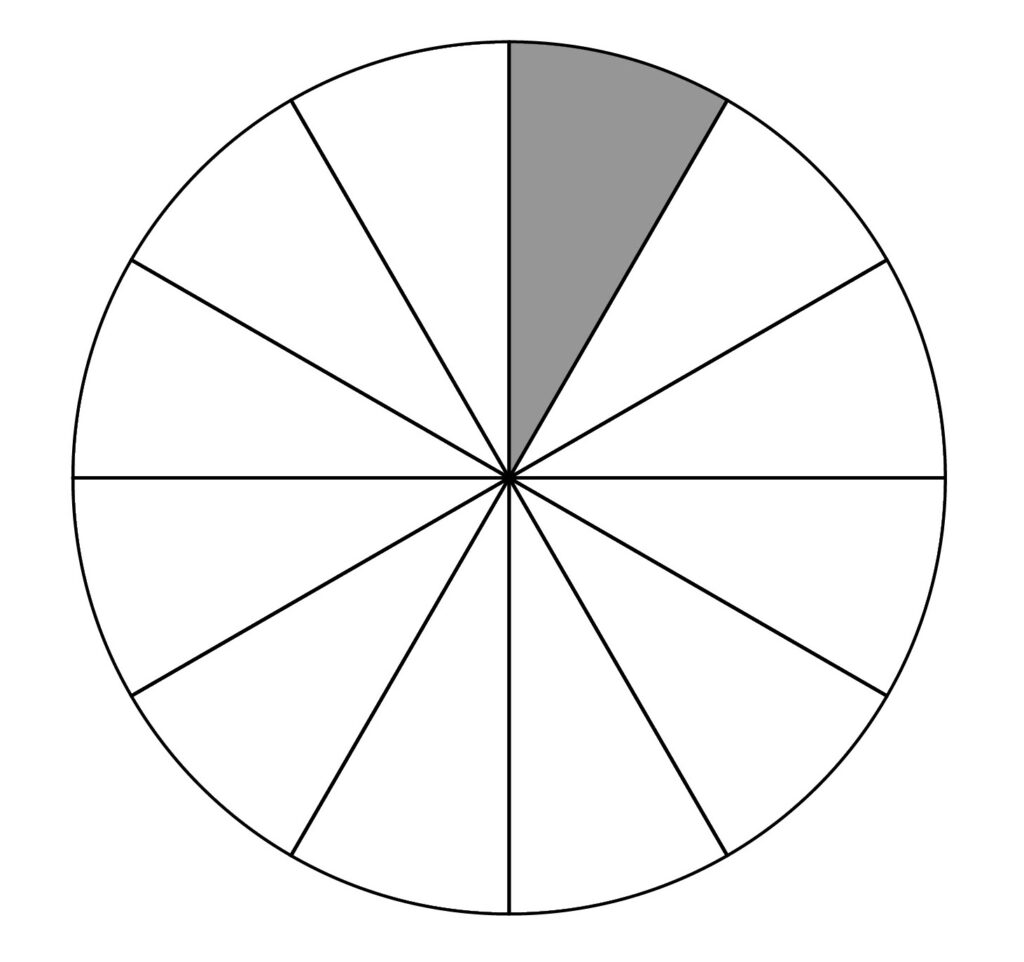
The ninth house is traditionally called God.
It is mainly connected with religion, philosophy, higher learning, astrology, long-distance travel, and divination. The Sun has his joy in this house.
Paulus of Alexandria connects the ninth house with:
“Gods, dreams, living abroad, astronomy and astrology, house of the Sun, the good cadent house.”
Abu Ma’shar links it with journeys, foreign travel, divinity, prophecy, faith, houses of worship, philosophy, astrology, divination, books, and dreams.
Al-Biruni includes travel, religion, fate, knowledge from the stars, philosophy, surveying, discernment, and the interpretation of visions and dreams.
These descriptions show that the ninth house is strongly connected with higher knowledge, belief, travel, and the search for meaning.

Main Topics of the Ninth House
The ninth house signifies:
- God
- religion and spirituality
- philosophy
- higher education
- higher knowledge
- astrology and astronomy
- travel and exploration
- pilgrimage
- foreign lands
- foreign affairs
- long-distance travel
- law and courts
- career sabbaticals
- retreat
- publishing
- dreams and visions
- divination
- prophets
Favorability of the Ninth House
The ninth house is cadent, but it aspects the Ascendant by trine.
For this reason, it is considered a favorable house.
It is also the joy of the Sun, which strengthens its connection with higher knowledge, religion, truth, and illumination.
Planets in the Ninth House
Planets placed in the ninth house can describe the native’s experience of religion, philosophy, higher education, foreign travel, astrology, or other ninth-house topics.
For example:
- Saturn in the ninth house can indicate traditional or serious forms of astrology, religion, philosophy, or higher study.
The planet’s nature and condition will show how these topics are expressed.
Derived House Meanings
The ninth house also has important derived meanings.
It may represent:
- spouse’s siblings: third from the seventh house
- sibling’s spouse: seventh from the third house
These meanings show how the ninth house can describe relatives connected through marriage.
Key Idea
The ninth house is the house of religion, higher knowledge, astrology, long-distance travel, and divination.
When judging it, consider:
- planets placed in the ninth house
- the ruler of the ninth house
- the condition of those planets
- how the planet’s nature connects with belief, learning, travel, and higher knowledge
This helps you judge how ninth-house topics may develop in the native’s life.
Tenth House: Midheaven
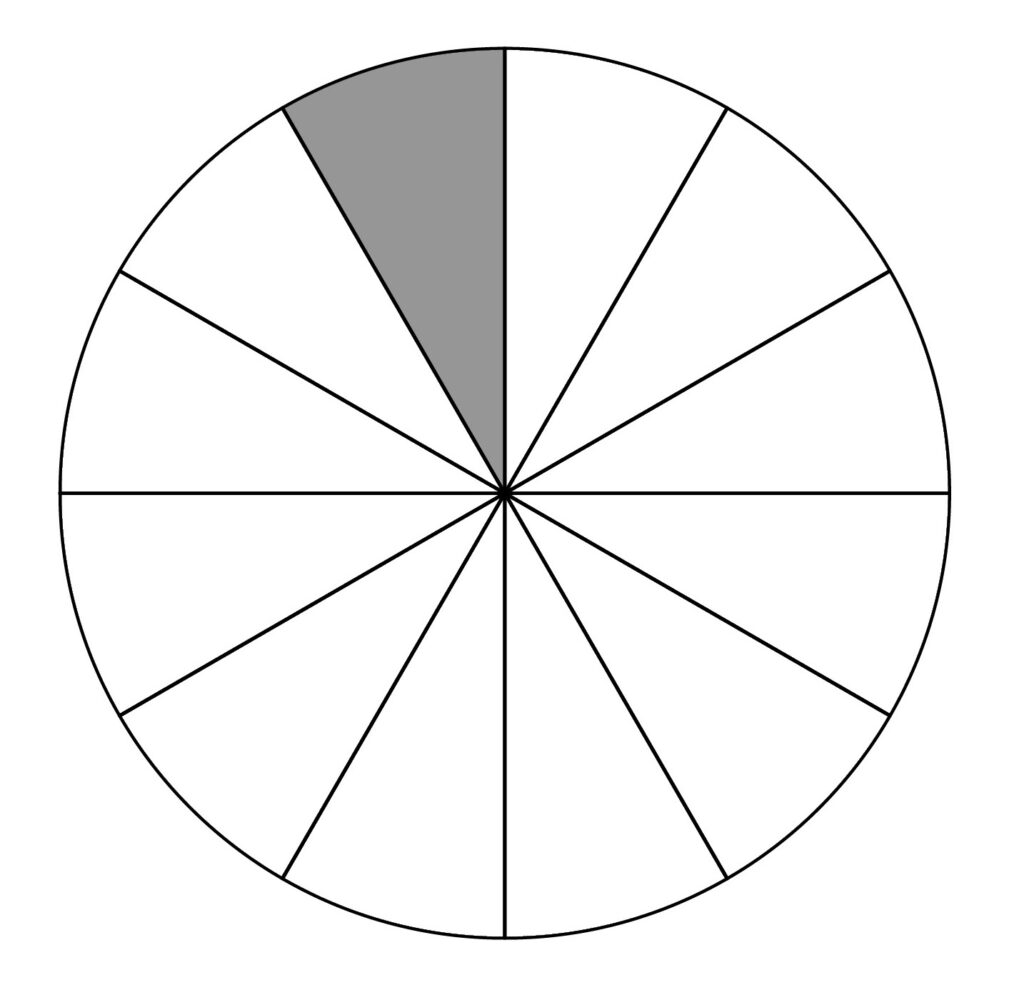
The tenth house is traditionally called the Midheaven.
It is mainly connected with career, profession, reputation, rank, authority, government, and the mother.
Paulus of Alexandria connects the tenth house with:
“Midheaven, activities of middle age, action, reputation, rank, standing, precedence, the father, the continuation of status, designated as place showing marriage and male children.”
Abu Ma’shar links it with authority, rulers, judges, nobility, fame, skills, actions, and mothers.
Al-Biruni includes government, authority, business, commerce, and professions.
These descriptions show that the tenth house is strongly connected with action in the world, public standing, and positions of responsibility.

Main Topics of the Tenth House
The tenth house signifies:
- mother
- career
- profession
- occupation
- reputation
- rank
- social status
- authority
- kings and rulers
- government
- regulatory bodies
Favorability of the Tenth House
The tenth house is angular and aspects the Ascendant.
For this reason, it is one of the most favorable and prominent houses in the chart.
Planets placed in the tenth house are usually powerful and visible. They often have a strong influence on the native’s profession, reputation, or public life.
Planets in the Tenth House
Planets in the tenth house can describe the native’s career, public role, or reputation.
For example:
- Venus in the tenth house may indicate a career connected with music, art, beauty, or entertainment.
A benefic planet in the tenth house may support success and recognition. A malefic may bring difficulty, delay, conflict, or pressure in career matters.
The planet’s overall condition must still be considered before making a final judgment.
Derived House Meanings
The tenth house also has an important derived meaning.
It may represent:
- death of a sibling: eighth from the third house
Key Idea
The tenth house is the house of career, reputation, authority, and public standing.
When judging it, consider:
- planets placed in the tenth house
- the ruler of the tenth house
- the condition of those planets
- how the planet’s nature connects with career, status, and authority
This helps you judge how the native may act in the public world and how they may be known by others.
Eleventh House: Good Spirit
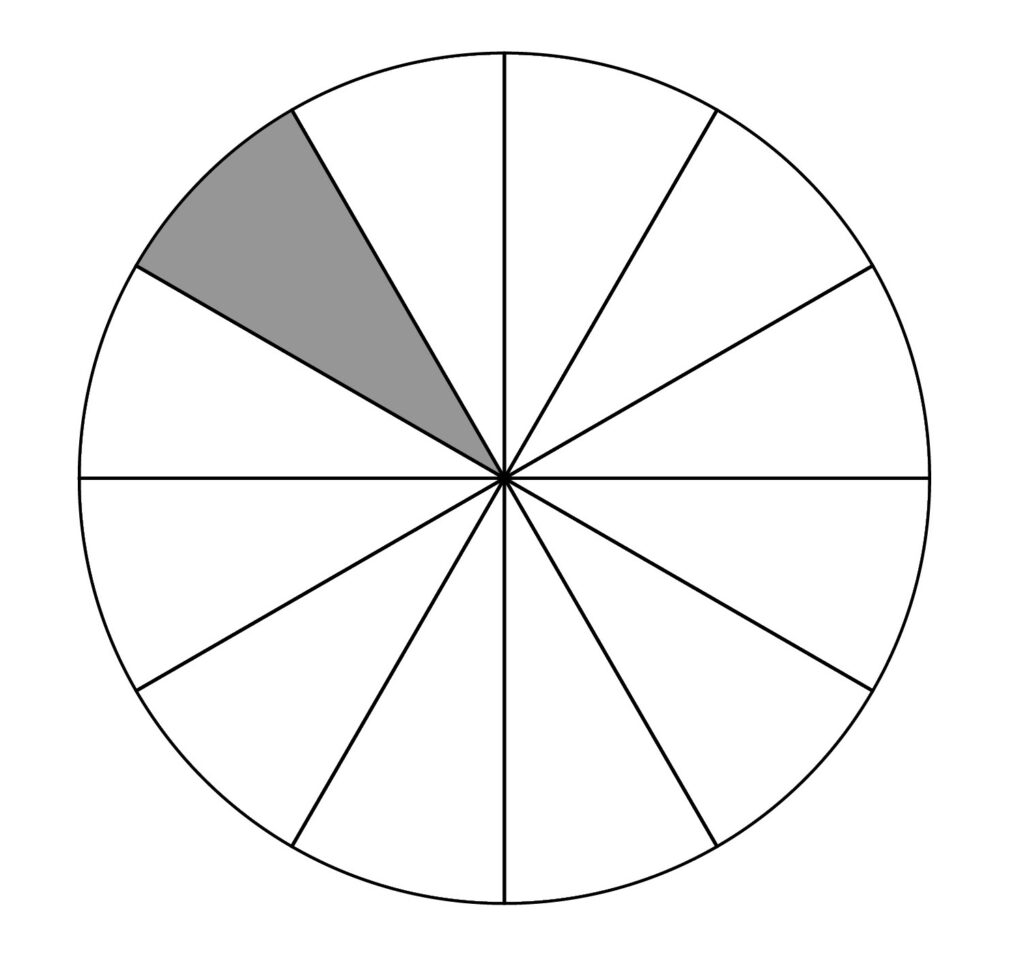
The eleventh house is traditionally called Good Spirit.
It is mainly connected with friends, alliances, groups, hopes, support, and favorable expectations. Jupiter has his joy in this house.
Paulus of Alexandria connects the eleventh house with:
“Joy of Jupiter, standing together, leadership, good expectations.”
Abu Ma’shar links it with hope, good fortune, friends, praise, children, and helpers.
Al-Biruni includes happiness, friends, prayer, praise, love, commerce, and longevity.
These descriptions show that the eleventh house is strongly connected with friendship, support, alliances, and hopes for the future.

Main Topics of the Eleventh House
The eleventh house signifies:
- friends and friendships
- groups
- organizations
- clubs
- legislative bodies
- cabinets
- politics
- political alliances
- other alliances
- hopes and wishes
- faith
- Good Spirit
Favorability of the Eleventh House
The eleventh house is succedent and aspects the Ascendant by sextile.
For this reason, it is considered a favorable house.
It is also the joy of Jupiter, which strengthens its connection with support, good fortune, friendship, hope, and beneficial alliances.
Planets in the Eleventh House
Planets placed in the eleventh house can describe friends, groups, allies, and the support the native receives from others.
A benefic planet may strengthen friendship, assistance, and good expectations. A malefic may bring difficulty, conflict, or disappointment through friends or groups.
The planet’s overall condition must still be considered before making a final judgment.
Derived House Meanings
The eleventh house also has several important derived meanings.
It may represent:
- income from profession: second from the tenth house
- king’s money or currency: second from the tenth house
- king’s men: second from the tenth house
- father’s death: eighth from the fourth house
- family debt or family inheritance: eighth from the fourth house
These meanings show how the eleventh house can connect career, authority, family, and financial topics.
Key Idea
The eleventh house is the house of friends, alliances, hopes, support, and Good Spirit.
When judging it, consider:
- planets placed in the eleventh house
- the ruler of the eleventh house
- the condition of those planets
- how the planet’s nature connects with friendship, groups, support, and hopes
This helps you judge how the native receives support and participates in groups, alliances, and friendships.
Twelfth House: Bad Spirit
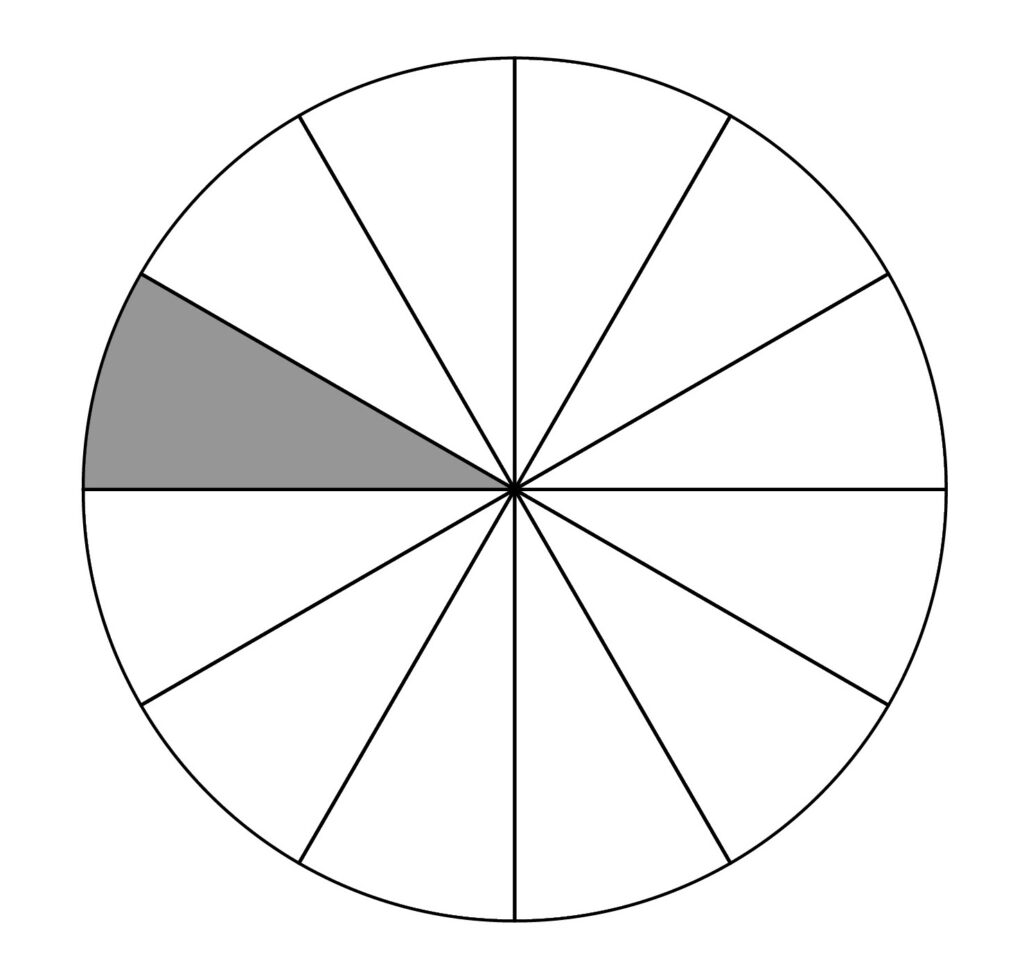
The twelfth house is traditionally called Bad Spirit.
It is mainly connected with enemies, suffering, fear, confinement, illness, hidden matters, and large animals. Saturn has his joy in this house.
Paulus of Alexandria connects the twelfth house with:
“True place of Saturn, evil divinity… sufferings, childbirth, enemies, male slaves, quadrupeds.”
Abu Ma’shar links it with enemies, misfortune, sadness, grief, envy, slander, punishment, accusations, fraud, prisons, captives, shame, loss, and animals.
Al-Biruni includes enemies, misery, anxiety, prison, debt, fines, fear, disease, servants, armies, exile, and unrest.
These descriptions show that the twelfth house is strongly connected with hardship, isolation, hidden threats, and situations that restrict freedom.

Main Topics of the Twelfth House
The twelfth house signifies:
- enemies
- secret enemies
- spies
- criminals
- fear and anxiety
- mistakes and self-undoing
- sorrow and grief
- suffering and misfortune
- illegal or illicit activity
- prisons and imprisonment
- confinement
- mental institutions
- hospitals and hospitalization
- illness
- secrets
- hidden knowledge
- covert activity
- large animals
- research
- libraries
Favorability of the Twelfth House
The twelfth house is cadent and does not aspect the Ascendant.
For this reason, it is in aversion to the first house and is considered one of the most unfavorable houses.
It is traditionally associated with suffering, fear, confinement, enemies, and loss.
Saturn rejoices in the twelfth house. This does not make the house favorable. Instead, it shows that Saturn is naturally suited to some of the difficult topics of this house, such as isolation, fear, restriction, and hardship.
Planets in the Twelfth House
Planets placed in the twelfth house can describe enemies, hidden matters, confinement, illness, research, or other twelfth-house topics.
For example:
- Mercury in the twelfth house may indicate hidden information, research, secret communications, or difficulties connected with speech and writing.
- Saturn in the twelfth house may intensify themes of isolation, fear, restriction, or prolonged suffering.
The planet’s nature and condition must always be considered before making a final judgment.
Small and Large Animals
Traditional astrology distinguishes between the sixth and twelfth houses when judging animals.
- 6th house: small or domesticated animals
- 12th house: large animals
For example, the sixth house may signify pets, while the twelfth house may signify large animals such as horses or elephants.
Derived House Meanings
The twelfth house is the eighth house from the fifth house.
For this reason, it may represent:
- death of children: eighth from the fifth house
- debt of children: eighth from the fifth house
Key Idea
The twelfth house is the house of enemies, suffering, confinement, fear, and hidden matters.
When judging it, consider:
- planets placed in the twelfth house
- the ruler of the twelfth house
- the condition of those planets
- how the planet’s nature connects with enemies, isolation, illness, and secrecy
This helps you judge how twelfth-house difficulties may appear in the native’s life.
General Significations of the Planets
The houses can signify specific people in the native’s life.
For example:
- 10th house: mother
- 4th house: father and grandfather
- 7th house: spouse or partner
- 3rd house: siblings
But houses are not the only way to identify people in a chart.
The planets also have general significations. This means that a planet can naturally represent certain kinds of people, regardless of the house it occupies.
For example:
- Sun: king, president, father, husband, powerful men
- Moon: mother, wife, women in general
- Venus: wife
- Mars: brothers
When judging a person in the native’s life, consider both the relevant house and the planet that naturally signifies that person.
For example, the father may be judged through the fourth house, but the Sun may also provide information because the Sun can naturally signify the father.
Key Idea
Use both house significations and planetary significations.
A house shows where a person or topic is located in the chart. A planet can also signify that person by its own natural meaning.
Keeping both levels in mind will help you make a more complete judgment.
4. Planets in Houses
In the previous lesson, you learned how to delineate a planet in a sign.
Now you will add the house.
The basic method is:
Planet + Sign + House
- The planet shows what is acting.
- The sign shows how the planet acts.
- The house shows where in life the action takes place.
To delineate a planet in a house, first combine the meaning of the planet with the topics of the house. Then add the sign to make the interpretation more specific.
The keywords approach you learned in the previous lesson works well here too.
Example 1: Mercury in the Ninth House
Mercury signifies:
- writing
- speech
- learning
- travel
- interpretation
- calculation
The ninth house signifies:
- religion
- philosophy
- higher learning
- astrology
- foreign travel
- publishing
When you combine Mercury with the ninth house, possible meanings include:
- tour guide
- writer on religion
- astrologer
- traveling spokesperson
- philosophy book
These are starting points. The rest of the chart will show which meanings are most relevant.
Adding the Sign: Mercury in Taurus in the Ninth House
Now add Taurus.
Taurus is associated with:
- beauty
- music
- nature
- steadiness
- practical form
Mercury in Taurus in the ninth house can therefore indicate:
- poetry on religion or philosophy
- a methodical astrology book
- an illustrated travel guide
- a traveling musician
Adding the sign gives more detail to the planet-house combination.
Example 2: Saturn in the Sixth House
Saturn signifies:
- restriction
- delay
- hardship
- discipline
- chronic conditions
- authority
The sixth house signifies:
- illness
- work
- servants
- employees
- labor
- the father’s siblings
Possible meanings include:
- chronic illness
- a strict uncle
- a difficult job
The uncle example comes from derived houses. The sixth house is the third house from the fourth house, so it can signify the father’s siblings.
Adding the Sign: Saturn in Gemini in the Sixth House
Gemini is associated with:
- communication
- learning
- hands and shoulders
- information
- technical or intellectual work
Saturn in Gemini in the sixth house can therefore indicate:
- chronic shoulder pain
- a scientist uncle
- work as a testing engineer
- labor regulations
Again, the sign makes the delineation more specific.
A Simple Method
When you delineate a planet in a house, follow this order:
- Identify the planet’s main meanings.
- Identify the house topics.
- Combine the two.
- Add the sign for more detail.
- Test the result against the rest of the chart.
Do not force every possible combination. Keep only the meanings that fit the planet, sign, house, and chart context.
Key Idea
A planet in a house gives you a basic life expression.
The planet shows what is acting.
The sign shows how it acts.
The house shows where it acts.
This three-part method forms the foundation for more detailed natal delineation.
5. Chart Examples
Jupiter in Gemini in the Tenth House: Charles Dickens
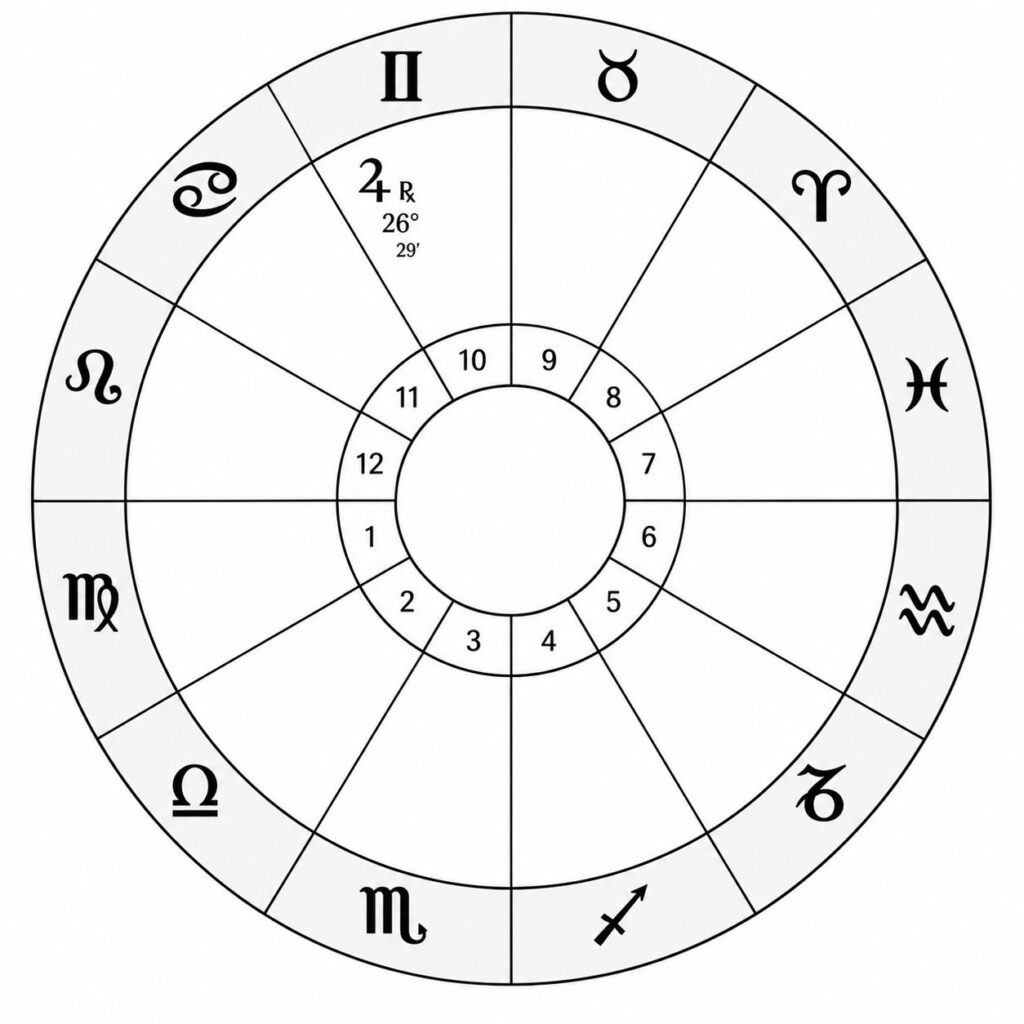
Charles Dickens has Jupiter in Gemini in the tenth house.
The tenth house has a house favorability grade of A+. It signifies career, profession, reputation, rank, and public status.
Jupiter is the greater benefic. It signifies prosperity, success, growth, and good fortune.
Gemini is associated with communication, reading, writing, and the exchange of information.
When we combine these three factors, we get a clear delineation:
Jupiter + Gemini + Tenth House
This can indicate success and recognition through writing, communication, or intellectual work.
That fits Charles Dickens very well.
Dickens became one of the most successful writers of his time. His literary output was extensive. He wrote 15 novels, five novellas, and hundreds of short stories and articles.
In this example:
- Jupiter brings growth, success, and abundance.
- Gemini gives writing, language, and communication.
- The tenth house places these themes in career, reputation, and public life.
The result is a highly visible and successful writing career.

The large number of characters Dickens created also fits the expansive nature of Jupiter operating through Gemini. His writing produced a broad and varied literary world filled with memorable people and stories.
Key Idea
Dickens shows how a benefic planet in a highly favorable house can support success in that area of life.
Jupiter in Gemini in the tenth house describes growth and recognition through writing and communication in the professional sphere.
Venus in Gemini in the Eleventh House: Petrarch
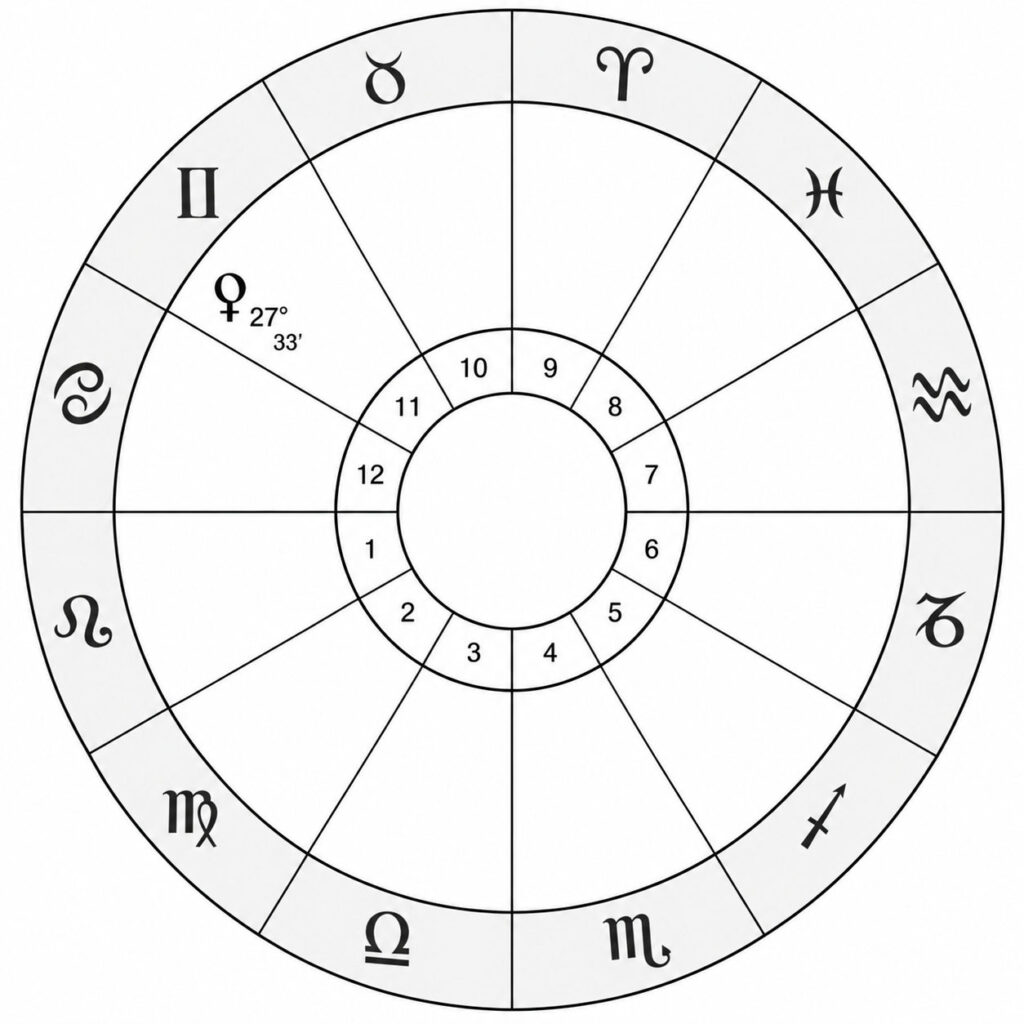
Petrarch has Venus in Gemini in the eleventh house.
The eleventh house has a house favorability grade of A. It is a favorable house connected with friends, groups, alliances, hopes, and support.
Venus signifies love, friendship, pleasure, harmony, and social connection.
Gemini adds communication, wit, variety, and the exchange of ideas.
When we combine these three factors, we get:
Venus + Gemini + Eleventh House
This can indicate pleasure and support through friends, correspondence, shared ideas, and intellectual companionship.
That fits Petrarch well.
Petrarch had many friends with whom he corresponded regularly. One of his closest friends was Giovanni Boccaccio, the writer and poet. They met, exchanged books, and worked together in the revival of classical texts.
Boccaccio also introduced Petrarch to a group of admirers in Florence. This gives us a clear example of Venus in the eleventh house working through friendship, groups, and social support.
In this example:
- Venus brings friendship, harmony, and connection.
- Gemini gives communication, letters, books, and intellectual exchange.
- The eleventh house places these themes among friends, groups, and alliances.
Key Idea
Petrarch shows how a benefic planet in a favorable house can support friendships and social connections.
Venus in Gemini in the eleventh house describes pleasure, friendship, and support through communication and shared intellectual interests.
Saturn in Gemini in the Tenth House: Nicolaus Copernicus
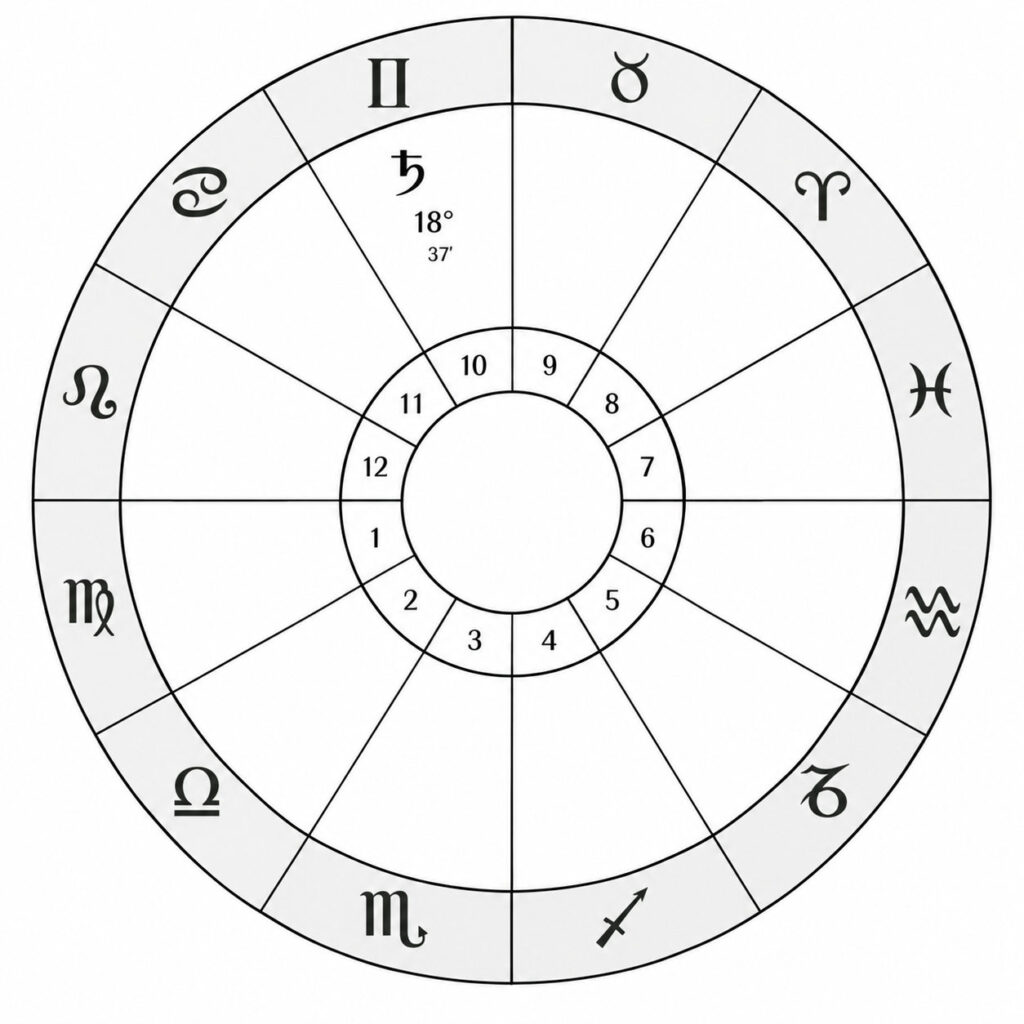
Nicolaus Copernicus has Saturn in Gemini in the tenth house.
The tenth house has a house favorability grade of A+. It signifies career, reputation, rank, and public status.
Saturn is the greater malefic. It signifies delay, obstruction, hardship, denial, and success that may come only after difficulty.
Gemini is associated with communication, reading, writing, and intellectual work.
When we combine these three factors, we get:
Saturn + Gemini + Tenth House
This can indicate difficulty, delay, or obstruction connected with writing, publication, and professional reputation.
That fits Copernicus well.
Copernicus had developed the basic ideas of his heliocentric model by around 1514, but his major work, On the Revolutions of the Heavenly Spheres, was not published until 1543. The delay lasted close to three decades.
The book itself was highly technical and difficult for general readers. Its first printing of about 400 copies did not sell out quickly.
In this example:
- Saturn brings delay, difficulty, and obstruction.
- Gemini gives writing, calculation, and intellectual work.
- The tenth house places these themes in career, reputation, and public achievement.
Comparing Copernicus with Dickens
This example becomes clearer when you compare it with Charles Dickens.
Both have a planet in Gemini in the tenth house, but the planets are very different.
Dickens has Jupiter in Gemini in the tenth house. Jupiter brings growth, success, and abundance. This fits his highly successful and prolific writing career.
Copernicus has Saturn in Gemini in the tenth house. Saturn brings delay, difficulty, and restriction. This fits the long struggle to publish his major work and the limited early response to it.
The sign and house are similar, but the planet changes the result.
Key Idea
Copernicus shows how a malefic planet can bring difficulty even when it is placed in a highly favorable house.
Saturn in Gemini in the tenth house describes delay and hardship connected with writing, publication, and professional reputation.
Mercury in Cancer in the Twelfth House: Bal Gangadhar Tilak
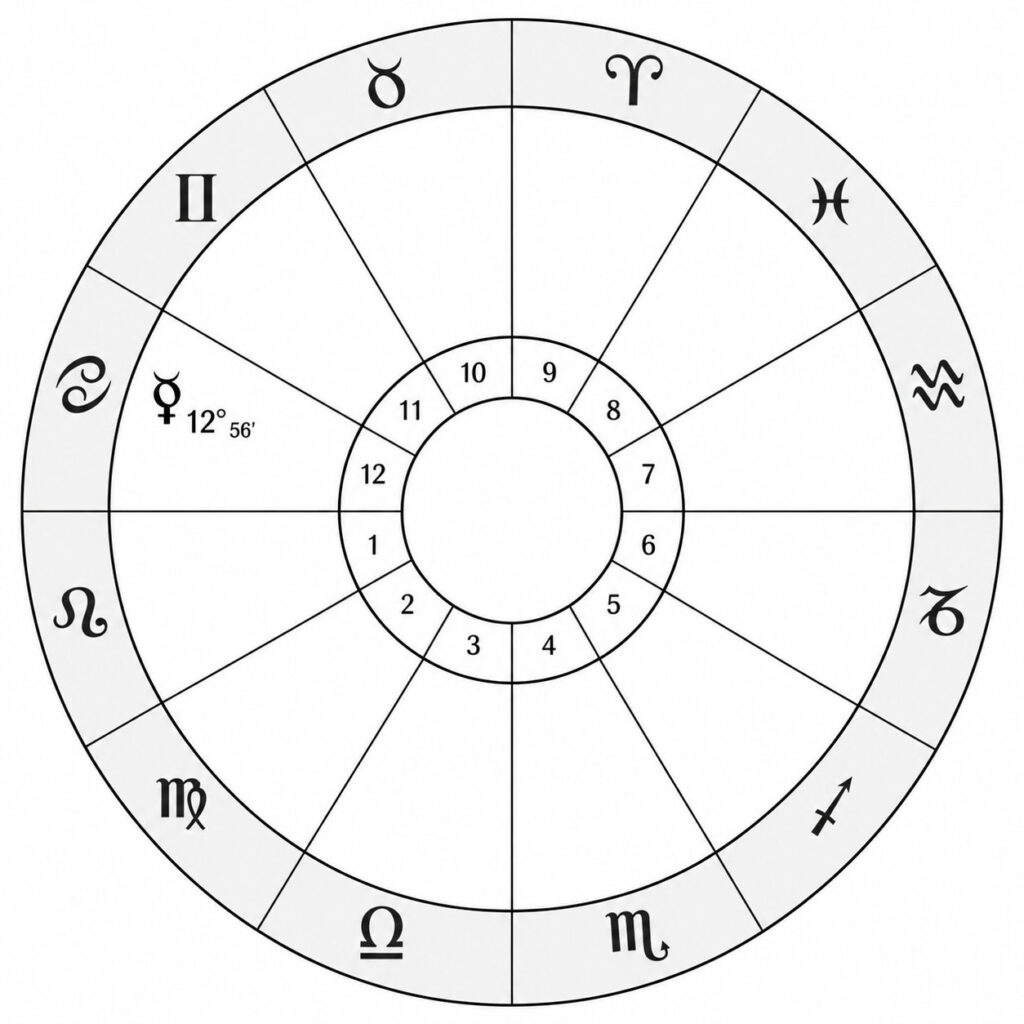
Bal Gangadhar Tilak has Mercury in Cancer in the twelfth house.
The twelfth house has a house favorability grade of D. It signifies enemies, suffering, confinement, imprisonment, hidden matters, and misfortune.
Mercury signifies writing, communication, information, learning, and the press.
Cancer is a protective, emotional, and responsive sign. It can also connect Mercury with family, care, and matters that stir public feeling.
When we combine these three factors, we get:
Mercury + Cancer + Twelfth House
This can indicate communication or writing connected with suffering, confinement, hidden matters, or imprisoned people.
That fits Tilak’s life well.
At the age of 24, Tilak and his friend Gopal Ganesh Agarkar started two newspapers, Kesari and The Mahratta. Their aim was to inform the public about political events and problems under British rule.
Around the same time, Shivaji VI, the young Maharaja of Kolhapur, was declared insane by British officials. Tilak’s newspapers disputed this claim and argued that the Maharaja was being badly treated and confined.
The newspapers brought public attention to the case. Rao Bahadur Barve then sued Tilak and Agarkar for defamation. Both men were sentenced to four months of rigorous imprisonment.
In this example:
- Mercury gives newspapers, writing, and communication.
- Cancer adds concern, protection, and emotional involvement.
- The twelfth house brings imprisonment, suffering, hidden matters, and enemies.
Mercury in the twelfth house can therefore describe both Tilak’s use of the press to expose a hidden situation and his own imprisonment that followed.
It can also describe another person connected with the native’s life. In this case, Mercury signifies the young Maharaja, whose confinement and suffering became a major subject of Tilak’s writing.
Key Idea
Tilak shows how a neutral planet can become connected with difficult events when placed in an unfavorable house.
Mercury in Cancer in the twelfth house describes writing and communication connected with suffering, confinement, hidden matters, and imprisonment.
It also shows an important rule of natal delineation: a planet can signify not only the native, but also other people and circumstances involved in the native’s life.
Related videos for this lesson
Lesson Summary
In this lesson, you learned how the twelve whole sign houses describe the areas of life in which planets act.
You studied house favorability, angular, succedent, and cadent houses, aversion to the Ascendant, planetary joys, and the main topics of all twelve houses. You also practiced combining planet, sign, and house meanings in example charts.
The main idea is simple:
A planet shows what is acting.
A sign shows how the planet acts.
A whole sign house shows where in life the action takes place.
In the next lesson, you will study quadrant houses. Quadrant houses are used primarily to judge planetary strength based on angularity.