
Discovering the Bounds
In traditional astrology, each zodiac sign is divided into five unequal segments called bounds, or terms. Each segment is ruled by one of the five traditional planets, excluding the luminaries: Saturn, Jupiter, Mars, Venus, or Mercury. Bounds are one of the five essential dignities and tell us whose “territory” within a sign a planet occupies. A planet in its own bound typically gains a degree of local authority and is sometimes compared to a governor—that is, a minor official exercising control over a particular territory.
In this series, we will examine the planet-sign combination of each bound, explore its traditional significations, and take a closer look at historical periods and notable figures connected with it. We begin with Saturn in Aquarius, the final five degrees of the sign, from 25°–30° in the Egyptian system of bounds.
“The remaining degrees, 5°, belong to Saturn: barren, moist, conceiving with difficulty, enfeebled, especially in the dura mater and the internal organs, afflicted with dropsy and fits, poor, with few brothers or children, envious, unlucky in their ends.”
Vettius Valens
The Bound of Saturn in Aquarius
Valens paints a bleak picture of this bound, but from a traditional perspective the reason is clear: Saturn is, after all, the Greater Malefic. Aquarius is an air sign, hot and moist by temperament, but was traditionally considered barren in ancient medical astrology and associated with connective tissues and the circulatory system.
To arrive at a more detailed, modern, and somewhat less dismal picture of this bound, let us first examine the characteristics of the sign and the planet before considering several historical periods and notable natives who embody its symbolism.
Aquarius: The Water Bearer
Aquarius is the eleventh sign of the zodiac, a masculine, fixed air sign, and the diurnal domicile of Saturn. Its symbol is a figure pouring water from a jug. In the Greco-Roman world, the Water Bearer’s constellation coincided with the late-winter rains, while the Romans called February Februarius, the month of purification.
The sign’s association with purification and fertility is ancient. The Babylonians linked it with the god Ea, ruler of the vast subterranean waters; the Egyptians with Hapi, the personification of the Nile; and the Greeks with Ganymede, the beautiful youth carried away by Zeus to serve as his cupbearer.
Saturn’s qualities of limits, restraint, and detachment shape the sign. Aquarius stands opposite Sun-ruled Leo, and the Sun is therefore in detriment here. Where Leo emphasizes the individual and concentrated authority, the Water Bearer tends toward the collective. Aquarius is associated with egalitarian ideals, a dislike of excessive hierarchy and privilege, and what might be called the ordinary person rather than the king.
Aquarians often take a detached, sometimes abstract interest in humanity as a whole, and many are drawn toward humanitarian concerns. Valens describes the sign as generous. Aquarius seeks to distribute its gifts, like water poured from a vessel and allowed to spread.

Astrologers as far back as Manilius associated Aquarius with canals and waterworks. There is some logic, then, behind Aquarius’s reputation as the “lost water sign.” Water was one of the primary conduits of transport, commerce, and communication in the ancient Mediterranean world. In modern terms, however, the Aquarian “water” can be understood more broadly as a medium of transmission or transport—whether waterways, the atmosphere, electrical currents, communications networks, or the internet.
Aquarians tend to be mild-mannered and outwardly sociable, yet as a fixed sign they may hold firm opinions and adhere to a fixed, somewhat abstract moral code. Like the other air signs, Aquarius is considered humane. Its natives tend to approach situations intellectually rather than emotionally, may sometimes be tactless, and can be uncomfortable with intimacy.
Most people may receive detached courtesy, while a chosen few friends matter deeply. Freedom of choice in friendship and relationships can therefore be paramount. The impartiality associated with air signs is tested here by Saturn’s need for structure, producing a tension between tolerance and intolerance, and between ideals and reality.
Aquarius is also associated with strong powers of concentration. Careers involving science, technology, aviation, space, teaching, and philosophy are common expressions of the sign. Traditionally, Aquarius rules the ankles and is associated with the circulatory system. Birds and flight are also linked with the sign, as are many forms of technology and transmission.
Saturn in Aquarius
In a broad sense, Saturn in Aquarius concerns the structures that bring people together.
Here, the cupbearer of the gods pours knowledge—or some other ambrosial substance—into the cups of humanity. In the past, that substance might have been education, equality, or transport. Today, it is often technological: the networks and systems that connect people, including the internet and social media.
For an individual, Saturn in Aquarius on a house cusp can represent the area of life in which connective structures and systems are established. Sometimes these systems may appear unnecessary or overly elaborate to others, particularly when the native is ahead of their time.
On the other hand, Saturn in Aquarius—especially when poorly conditioned or afflicted by Mars—can describe fear surrounding groups or friendships. Although the Aquarian archetype may shy away from the solar ideal of individual leadership, Saturn in Aquarius can benefit greatly from taking responsibility for the development of a group, whether that group consists of friends, colleagues, an organization, or society itself.
Such natives may find purpose through working with marginalized groups or by becoming authorities in technological fields. They may possess a strong sense of social responsibility and often form important relationships with older people or authority figures.
Saturn in its own bound in Aquarius is a strong position in terms of essential dignity. It becomes still more supported in a day chart, since Saturn is the diurnal malefic and participates in the air triplicity by day.
Saturn/Aquarius Periods
Looking at historical periods connected with Saturn/Aquarius can help bring some of the core significations of this planet-sign combination into clearer focus.
In his book America Is Born, Dr. H connects several events of the late 1820s with Saturn/Aquarius through a primary direction technique known as the Distributor. In the Regulus USA horoscope, the directed Ascendant moved through the bound of Saturn in Aquarius from March 18, 1827, to June 24, 1830. Dr. H pays particular attention to events occurring around the exact transition into this bound, using them as evidence in support of the chart rectification.
One striking example occurred on March 17, 1827, just one day before the Saturn/Aquarius period began, when U.S. President John Quincy Adams ordered American ports closed to British goods. The symbolism is unusually literal: Saturn signifies closure and restriction, while Aquarius is associated with waterways, transport, and waterworks.
Two other events from the same period illustrate different sides of the Saturn/Aquarius symbolism. The first issue of Freedom’s Journal, the first African American newspaper published in the United States, appeared on March 16, 1827, two days before the transition. Its role in the emerging abolition movement connects Saturn/Aquarius with attempts to create more equitable social structures.
Dr. H also notes, through his keyword technique, that Aquarius’s association with the ankles, combined with Saturn’s associations with bondage, and restriction, can signify leg shackles—the very objects from which abolitionists sought to free enslaved people. Saturn/Aquarius can therefore describe both the mechanisms of oppression and the effort to dismantle them.
A further example is the Lyceum Movement, whose first cooperative was established in early 1827. The movement brought adult education to the public across much of the northeastern United States. The organization and distribution of knowledge to ordinary people closely reflects another Saturn/Aquarius theme: the creation of structures through which knowledge can be shared widely.
Since 1800, Saturn has occupied its own bound in Aquarius during the following periods:
| Period | Saturn in 25°–30° Aquarius |
| 1817 | Feb 3 – Mar 17; Oct 5 – Dec 1 |
| 1846–47 | Mar 13 – May 10; Jul 14 – Sep 26; Nov 30, 1846 – Jan 25, 1847 |
| 1875–76 | Apr 30 – Jul 14; Jan 19 – Mar 1, 1876 |
| 1905–06 | Feb 26 – Apr 13; Aug 17, 1905 – Jan 9, 1906 |
| 1934–35 | Apr 5 – Aug 16; Jan 1 – Feb 15, 1935 |
| 1964 | Feb 10 – Mar 24; Sep 17 – Dec 16 |
| 1993–94 | Mar 17 – May 21; Jun 30 – Sep 17; Dec 7, 1993 – Jan 29, 1994 |
| 2022–23 | May 18 – Jun 23; Jan 25 – Mar 8, 2023 |
Several periods from the last century stand out.
1934: The Night of the Long Knives on June 30 and the merging of the offices of President and Chancellor in Germany following Hindenburg’s death on August 2 both occurred during Saturn’s first pass through its own bound in Aquarius. The period vividly reflects Saturn as authority, consolidation, restriction, and the restructuring of political power into a more rigid system.
The Saturn/Aquarius symbolism also appears through Albert Speer, who was born with Saturn in Aquarius. After architect Paul Ludwig Troost died in January 1934, Speer became Hitler’s principal architect and took on increasingly important architectural and organizational roles within the Nazi regime. His work on monumental architecture and large-scale construction offers another expression of Saturn/Aquarius: Saturnian structure, planning, and authority applied through the Aquarian concern with systems and collective organization. The same symbolism would become still more pronounced later in Speer’s career, as his responsibilities expanded from architecture into the administration of vast industrial and construction systems.
1964: Martin Luther King Jr. received the Nobel Peace Prize on December 10 during Saturn’s autumn pass through the bound. The Civil Rights Act, signed on July 2, fell between Saturn’s two passes, when the planet had temporarily moved back into Pisces.
1993: CERN made the World Wide Web publicly available on April 30, during the spring pass—a striking Aquarian combination of technology, openness, transmission, and shared networks. Later that year, the Oslo Accords between Israel and the Palestine Liberation Organization were signed on September 13, while Nelson Mandela and F. W. de Klerk shared the Nobel Peace Prize on December 10. Both events fell within later passes and concerned, in different ways, the dismantling of barriers between peoples.
Let us now look at three historical figures whose lives express different facets of the Saturn/Aquarius archetype. None has Saturn in Saturn’s own Aquarian bound natally, but each provides an illuminating example of the broader planet-sign combination.
George Boole: A System of Knowledge
George Boole was born on November 2, 1815, in Lincoln, England. The son of a struggling shoemaker, he was largely self-taught, learning Latin and modern languages on his own before beginning to teach at sixteen to support his family. He opened his own school at nineteen.
Without attending university, Boole published The Mathematical Analysis of Logic in 1847, introducing the system that came to be known as Boolean algebra. In 1854, An Investigation of the Laws of Thought developed logic into a mathematical system of binary values, laying foundations that would later become fundamental to modern computing. In 1849, he became the first Professor of Mathematics at Queen’s College, Cork.
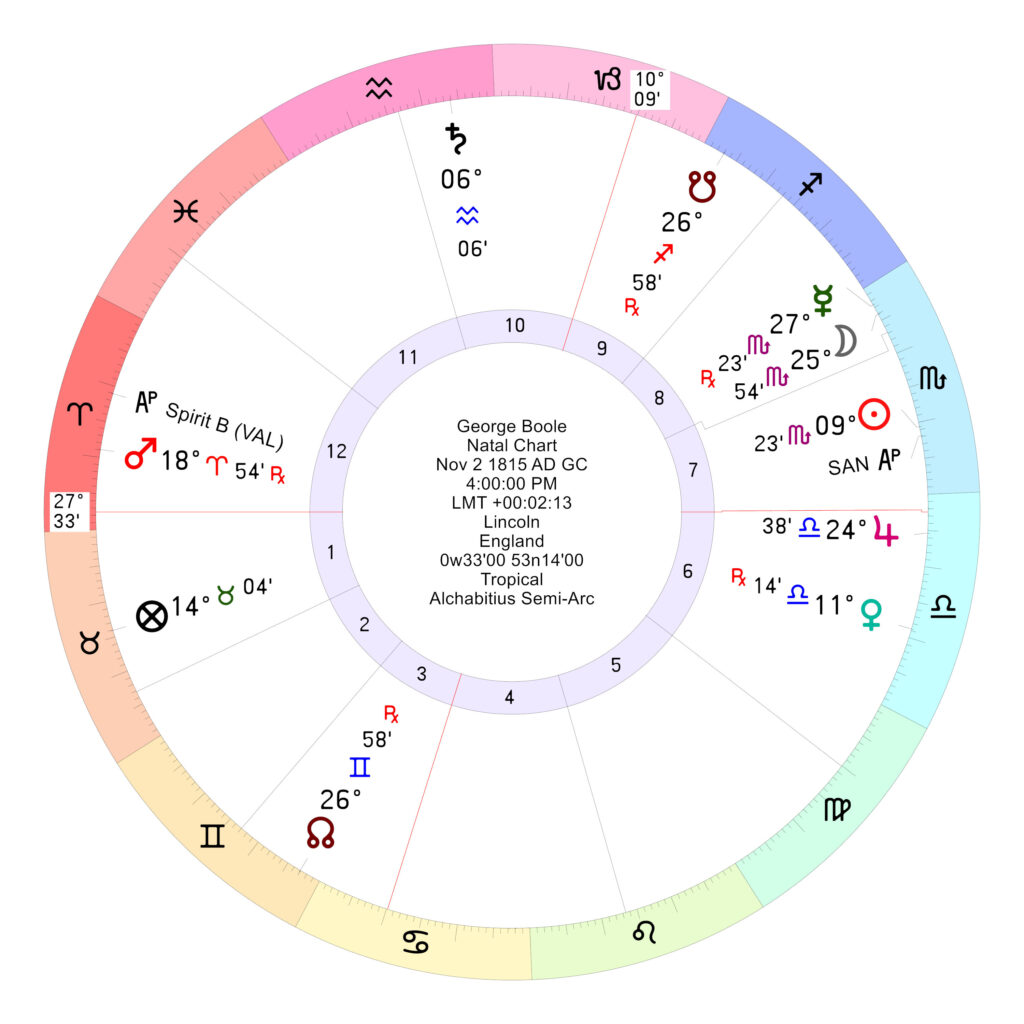
His chart places Saturn at 6°06′ Aquarius, in domicile and in Mercury’s bound from 0°–7°. Mercury sits at 27°23′ Scorpio, retrograde and in Saturn’s bound of Scorpio from 24°–30°, while the Moon at 25°54′ Scorpio also occupies Saturn’s bound.
Saturn and Mercury therefore stand in one another’s bounds, creating a mutual reception by bound and connecting the planet of rules and systems with the planet of reasoning, symbols, and language. Mercury’s retrogradation also fits a mind that returned to and reconsidered the foundations of logic itself.
The Aquarian significations are readily apparent. Saturn in Aquarius establishes rules and systems, and The Laws of Thought does exactly that. Boole’s self-education parallels the adult-learning symbolism of the Lyceum Movement, while his lifelong friendships with fellow mathematicians Augustus De Morgan and Arthur Cayley echo Aquarius’s emphasis on friendship and intellectual association.
His Saturn return around 1844–45 coincided with his Royal Society medal. Saturn then crossed its own Aquarian bound from late 1846 into January 1847, shortly before publication of the work that launched Boolean algebra.
The end of Boole’s life reads almost like a commentary on Valens. He died on December 8, 1864, aged 49, following fever and pleural effusion after walking to Queen’s College in heavy rain. His wife, believing that the cure should resemble the cause, reportedly poured water over him.
Fluid in the chest—recalling Valens’s “moist” condition and affliction of the internal organs—combined with an attempted water cure and an early death provides a striking expression of the less fortunate side of the symbolism.
Carl Sagan: Science for the Common Man
Carl Sagan was born on November 9, 1934, in Brooklyn, New York. He earned his PhD from the University of Chicago in 1960, lectured at Harvard, and from 1968 taught at Cornell, where he directed the Laboratory for Planetary Studies.
He contributed to the Mariner, Viking, and Voyager missions and played an important role in the Pale Blue Dot photograph taken in 1990. His 1980 television series Cosmos brought science and astronomy to an enormous public audience. He also co-founded The Planetary Society in 1980 and became a prominent advocate for nuclear disarmament, environmental protection, and scientific skepticism.
Sagan died on December 20, 1996, aged sixty-two, from complications of myelodysplasia that led to pneumonia.
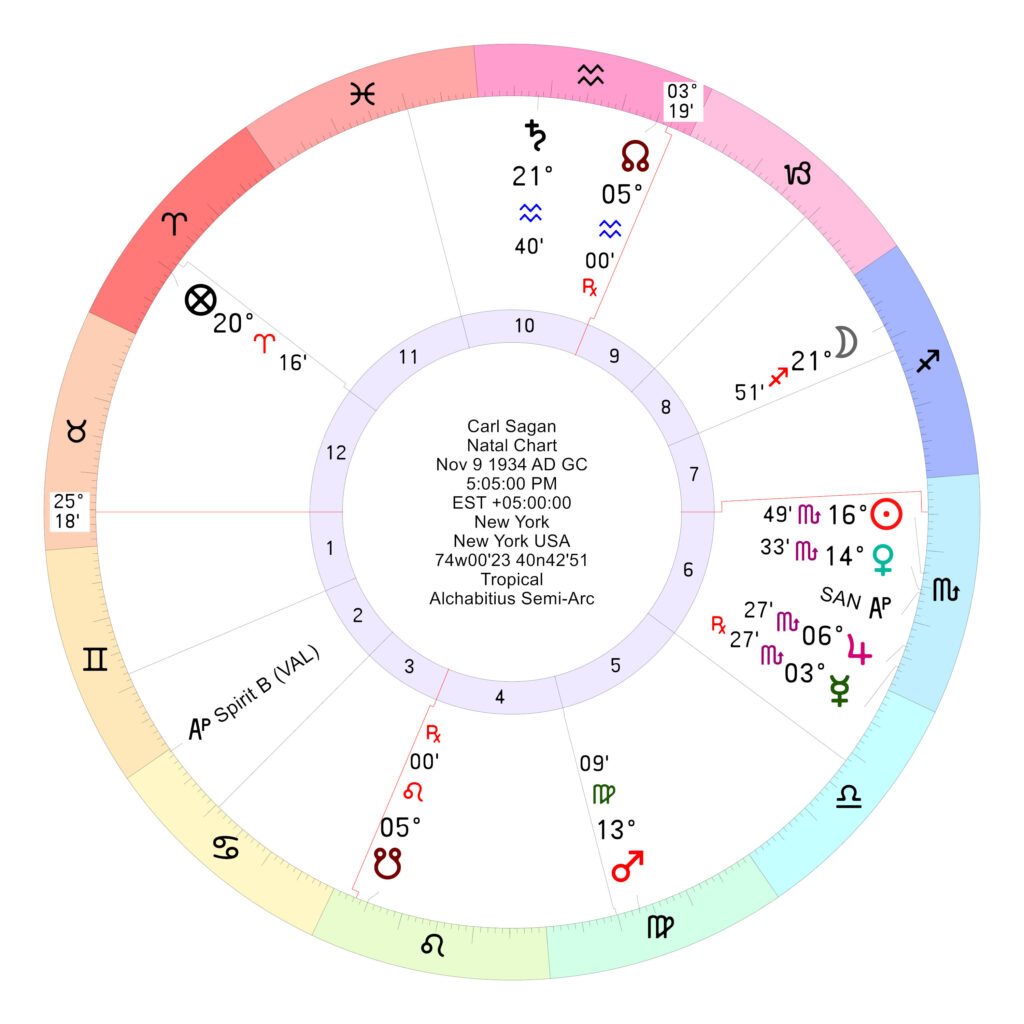
Sagan’s Saturn is at 21°40′ Aquarius, in the bound of Mars from 20°–25°, but still powerfully placed in its own domicile. His Moon at 21°51′ Sagittarius falls in Saturn’s bound from 21°–26°, making a domiciled Saturn the Moon’s bound lord. He was also born between the two passes of Saturn through its own Aquarian bound in 1934–35.
Aquarian themes map readily onto his life: science and technology; the sky and flight through spacecraft; and intellectual progress deliberately made accessible rather than confined to an elite.
The Pale Blue Dot, showing humanity compressed into a tiny point of light, makes visible one of the sign’s central ideas: the individual placed within a much larger human whole. Sagan’s Cosmos brought complex scientific ideas to ordinary viewers through public television, while his wider advocacy expressed Saturn’s sense of social responsibility.
Here the Water Bearer distributes knowledge—not to a select group, but to everyone willing to receive it.
Jeff Bezos: Building E-Commerce Infrastructure
Jeff Bezos was born on January 12, 1964, in Albuquerque, New Mexico, and was raised in Houston and Miami. He graduated from Princeton in 1986 with degrees in electrical engineering and computer science and became the youngest senior vice president at D. E. Shaw in 1990.
In 1994, he left the firm to found Amazon, reportedly writing the business plan during a drive to Seattle. The website launched in July 1995. Bezos later founded Blue Origin in 2000, purchased The Washington Post in 2013, and flew into space aboard New Shepard on July 20, 2021.
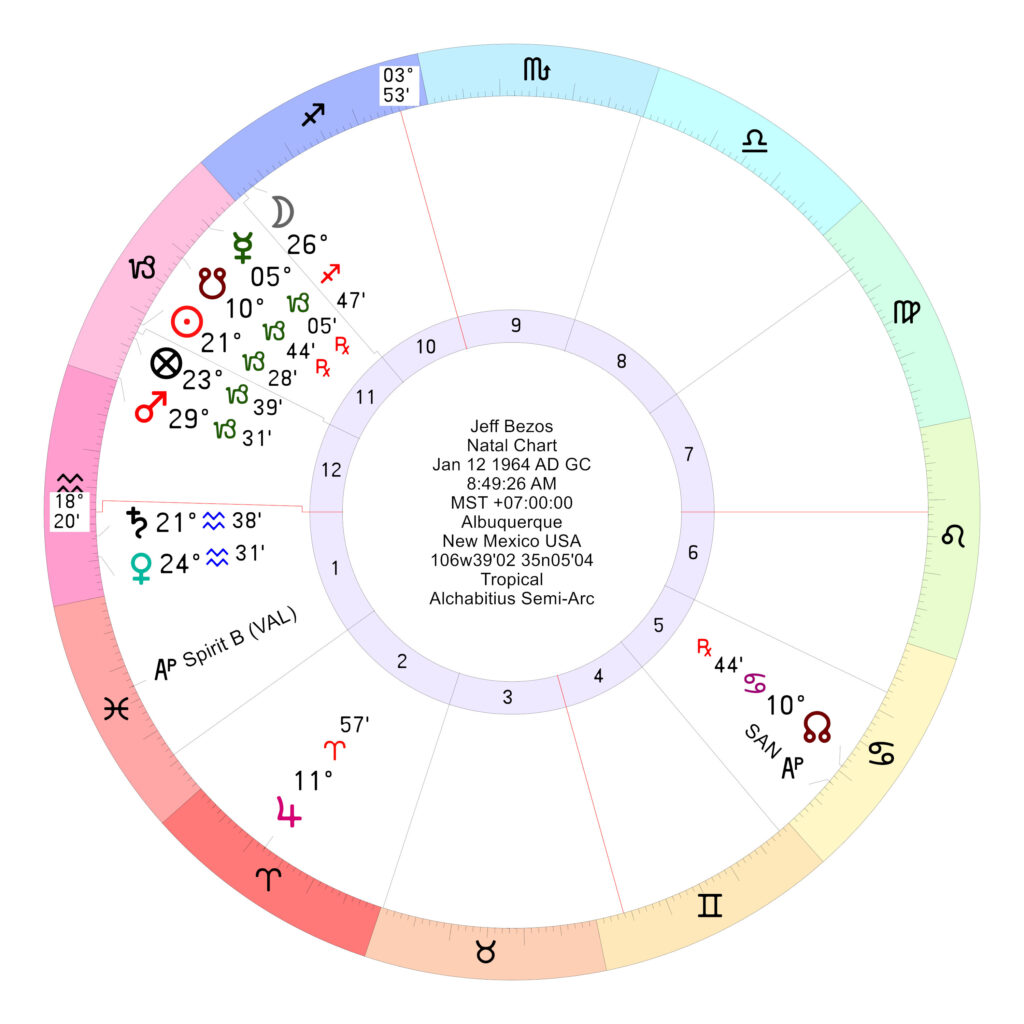
His Saturn is at 21°39′ Aquarius—within a single minute of arc of Sagan’s Saturn—and, like Sagan’s, occupies the bound of Mars. Venus at 24°41′ Aquarius lies only 19 minutes short of Saturn’s bound.
Mars at 29°38′ Capricorn is exalted and occupies its own bound of Capricorn from 26°–30°, giving it considerable dignity. Saturn, as domicile ruler of Capricorn, also disposes of Bezos’s Sun at 21°36′ Capricorn and Mercury at 5°02′ Capricorn. A strong Saturn in Aquarius therefore governs a substantial portion of the chart.
The Saturn/Aquarius connections are conspicuous. Bezos developed an early interest in science and technology, trained as an engineer, and later pursued flight and space travel through Blue Origin.
Amazon can also be understood through the older Aquarian symbolism of internal improvements and routes connecting people and commerce. Instead of canals carrying goods between distant communities, Amazon constructed digital and logistical routes linking buyers, sellers, information, warehouses, and transportation networks on a massive scale.
The timing is also notable. Bezos’s first Saturn return occurred around early 1993. Saturn made three passes through its own Aquarian bound during 1993–94, with the final pass ending in January 1994. Later that year, Bezos left D. E. Shaw and founded Amazon.
The Water Bearer’s infrastructure had become digital.
Conclusion
Saturn in Aquarius combines Saturn’s rules, structures, and limits with the Water Bearer’s impulse to distribute knowledge, resources, or access across a wider human network.
Valens’s bleak description reminds us that Saturn remains the Greater Malefic. Yet the historical symbolism surrounding Saturn/Aquarius reveals a more complex picture: abolition, adult education, civil rights, the open web, technological networks, and systems intended to connect ordinary people. The same combination can build barriers or dismantle them, impose restrictions or establish structures that make wider participation possible.
Boole, Sagan, and Bezos illustrate three distinct forms of this archetype. Boole created a system of logic. Sagan brought science to a mass audience. Bezos built a commercial and technological network for the public.
Across all three, the underlying pattern is remarkably consistent.
Saturn supplies the structure.
Aquarius determines where it flows.
And when the two work together, the result is often an aqueduct: a durable structure designed to carry something valuable from one place to many others.